The world is changing faster than ever, and at the heart of this transformation are the Artificial Intelligence Trends that are quietly but powerfully reshaping every industry, every job function, and every aspect of human life. Whether you are a business owner, a student, a developer, or simply a curious mind, understanding where AI is headed is no longer optional. It is essential. From the way we search the internet to how doctors diagnose diseases and how governments make policy decisions, artificial intelligence has become the invisible engine driving the modern era.
Over the past few years, AI has moved from being a futuristic concept discussed in academic papers to a practical, everyday tool embedded in the products and services millions of people use without even thinking twice. But the pace of change is accelerating, and 2025 is shaping up to be one of the most pivotal years in AI history. The breakthroughs happening right now are not just incremental upgrades. They represent entirely new categories of capability that were considered science fiction just a decade ago.
- Artificial Intelligence Trends in Generative AI and Creative Automation
- Artificial Intelligence Trends in Agentic AI and Autonomous Systems
- Artificial Intelligence Trends in Healthcare and Life Sciences
- Artificial Intelligence Trends Transforming the Workplace
- Artificial Intelligence Trends in Edge AI and Real-Time Processing
- Artificial Intelligence Trends in AI Regulation and Ethical Governance
- Artificial Intelligence Trends in Multimodal AI and Unified Intelligence
- The Path Forward
- Frequently Asked Questions
Artificial Intelligence Trends in Generative AI and Creative Automation
One of the most visible Artificial Intelligence Trends today is the explosive growth of generative AI. This technology goes beyond analyzing data or making predictions. It creates. It writes, designs, codes, composes music, and generates lifelike images and videos from simple text instructions. What began as an interesting experiment has now become a core business tool adopted across marketing, entertainment, education, healthcare, and beyond.
Generative AI is fundamentally changing creative workflows. Teams that once needed weeks to produce content are now compressing those timelines into hours. The implications for productivity are enormous, but so are the questions around originality, intellectual property, and the human role in creative industries. The trend is not about replacing human creativity. It is about augmenting it, giving creators superpowers they never had before.
Key capabilities driving this shift include:
Text generation for long-form content, reports, emails, and scripts
Image and video synthesis from written prompts
AI-generated code that accelerates software development
Real-time voice and audio generation for media production
Artificial Intelligence Trends in Agentic AI and Autonomous Systems
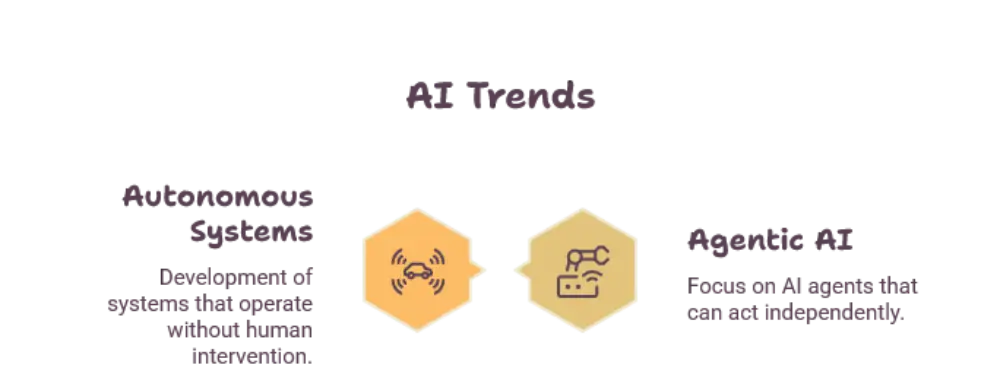
Perhaps the most significant frontier in current Artificial Intelligence Trends is the rise of agentic AI. Unlike traditional AI tools that respond to a single prompt and stop, agentic AI systems can plan, reason across multiple steps, use tools, browse the web, execute tasks, and adapt based on changing conditions. These systems are beginning to operate with a level of autonomy that brings us closer to what researchers call artificial general intelligence.
Businesses are already deploying AI agents to handle customer service workflows, manage data pipelines, conduct research, and even make scheduling decisions without constant human supervision. The implications are profound. Organizations that learn how to deploy and manage agentic AI effectively will enjoy a significant productivity advantage over those that do not.
What makes agentic AI particularly compelling is its ability to combine multiple AI models and external tools into a coordinated system. One agent might browse the web for research, another might write a report based on those findings, and a third might send it to the right people at the right time. All of this can happen with minimal human intervention.
Artificial Intelligence Trends in Healthcare and Life Sciences
Among all sectors being transformed, healthcare stands out as one of the most exciting frontiers for Artificial Intelligence Trends. AI is being used to detect diseases earlier than ever before, accelerate drug discovery, personalize treatment plans, and reduce administrative burdens that consume enormous amounts of clinician time.
AI models trained on medical imaging data can now identify early-stage cancers, diabetic retinopathy, and neurological conditions with a level of accuracy that rivals experienced specialists. In drug discovery, AI is dramatically compressing the timeline from initial compound identification to clinical trial by predicting how molecules will behave inside the human body.
The real promise of AI in healthcare is democratization. In parts of the world where access to specialist doctors is limited, AI-powered diagnostic tools can bring a baseline of expert-level care to communities that have never had it before.
Artificial Intelligence Trends Transforming the Workplace
The conversation about AI and jobs has become one of the most hotly debated topics of our time. The reality is more nuanced than the headlines suggest. While AI is automating certain tasks, it is simultaneously creating entirely new categories of work. Understanding and navigating these Artificial Intelligence Trends is critical for both employers and employees.
What is clear is that the skills most valued in the AI era are not purely technical. Critical thinking, creativity, emotional intelligence, and the ability to work alongside AI systems are becoming the defining competencies of the modern workforce. Organizations are investing heavily in AI literacy programs because they recognize that a workforce that understands AI is a workforce that can harness it effectively.
Key workplace transformations underway include:
AI-assisted coding tools helping developers write faster and more accurate code
Intelligent document processing replacing manual data entry across finance and legal sectors
AI scheduling and task management tools optimizing productivity at scale
Real-time language translation enabling seamless global collaboration
Artificial Intelligence Trends in Edge AI and Real-Time Processing
Another major development in Artificial Intelligence Trends is the movement of AI processing from centralized cloud servers to edge devices. Edge AI refers to the ability to run AI models directly on smartphones, smart speakers, cameras, vehicles, and industrial sensors without needing to send data to the cloud.
This shift matters enormously for speed, privacy, and reliability. When an autonomous vehicle needs to make a split-second decision, it cannot afford the latency of a round trip to a cloud server. When a healthcare device is monitoring a patient’s vitals, processing that data locally means faster responses and better protection of sensitive information.
Edge AI is enabling a new generation of intelligent devices that are smarter, faster, and more private than anything that came before. The proliferation of 5G networks and more powerful chips is accelerating this trend dramatically.
Artificial Intelligence Trends in AI Regulation and Ethical Governance
With enormous power comes the need for thoughtful governance. One of the most important Artificial Intelligence Trends of 2025 is the accelerating push from governments, institutions, and civil society organizations to establish ethical frameworks and regulatory guidelines for AI development and deployment.
Conversations around AI fairness, transparency, accountability, and safety are moving from philosophy departments into boardrooms and legislative chambers. Regulators around the world are working to ensure that AI systems do not perpetuate bias, violate privacy, or cause harm without recourse.
For businesses, this means that responsible AI is no longer a nice-to-have. It is increasingly a legal and reputational requirement. Organizations that build AI systems with ethics and transparency at their core will be better positioned to earn trust from customers, partners, and regulators.
Artificial Intelligence Trends in Multimodal AI and Unified Intelligence
Traditional AI systems were built to do one thing well. They either analyzed text or processed images or recognized speech. The newest wave of AI is multimodal, meaning it can simultaneously understand and generate across text, images, audio, video, and code. This unified intelligence is unlocking entirely new use cases that were previously impossible.
Imagine asking an AI to analyze a complex technical diagram, explain what it shows in plain language, suggest improvements, and then generate updated design files. All in one seamless interaction. Multimodal AI makes this possible, and as these capabilities continue to improve, they will fundamentally change the way humans and machines interact.
The fusion of different modalities into a single coherent AI experience represents one of the most exciting directions in current Artificial Intelligence Trends, bringing us closer to AI systems that understand the world the way humans do, through sight, sound, language, and context together.
The Path Forward
Staying informed about Artificial Intelligence Trends is not just for technologists. It is for anyone who wants to understand the world they live in and thrive in the years ahead. The organizations and individuals who engage with AI proactively, building literacy, experimenting with tools, and contributing to ethical conversations, will be the ones who shape what this technology becomes. The future of AI is not predetermined. It is being written right now, by all of us.
Frequently Asked Questions
What are the most important Artificial Intelligence Trends in 2025?
The most significant trends include generative AI, agentic AI systems, edge AI, multimodal intelligence, and AI-driven transformation in healthcare and the workplace. These areas are seeing the fastest growth and the most real-world adoption.
How are Artificial Intelligence Trends affecting jobs?
AI is automating routine and repetitive tasks while simultaneously creating new roles focused on AI oversight, prompt engineering, data curation, and AI ethics. Workers who develop AI literacy are better positioned to adapt and thrive.
Is generative AI one of the leading Artificial Intelligence Trends?
Yes, generative AI is among the most visible and impactful trends. It is transforming creative industries, marketing, software development, and education by enabling machines to produce high-quality content from simple instructions.
How will Artificial Intelligence Trends impact healthcare?
AI is accelerating disease detection, drug discovery, personalized medicine, and administrative efficiency in healthcare. It holds particular promise for improving access to quality diagnostic tools in underserved regions of the world.
What role does ethics play in current Artificial Intelligence Trends?
Ethics and governance are becoming central to AI development. Regulators, businesses, and researchers are working together to establish standards for fairness, transparency, and safety to ensure that AI benefits society responsibly.