
AI in Finance is quickly becoming one of the most talked about developments in the global economy. Banks, insurance firms, investment houses, and fintech startups are all adopting artificial intelligence to make faster decisions, understand customers better, and manage risk more effectively. What was once a futuristic idea is now a practical tool shaping how money moves, how loans are approved, and how markets behave every single day.
In this article, we will explore what AI in finance really means, where it is being used, the benefits it brings, the challenges organizations face, and what the future may look like as this technology continues to mature.
What Is AI in Finance
AI in finance refers to the use of machine learning, natural language processing, and predictive analytics to automate and improve financial processes. Instead of relying purely on manual analysis, financial institutions now use intelligent systems that can scan huge volumes of data, identify patterns, and generate insights in seconds.
This shift allows companies to move away from slow, paper heavy workflows toward systems that are proactive, data driven, and increasingly autonomous. From detecting suspicious transactions to predicting market trends, AI has become an essential part of modern financial infrastructure.
Key Applications of AI in Finance
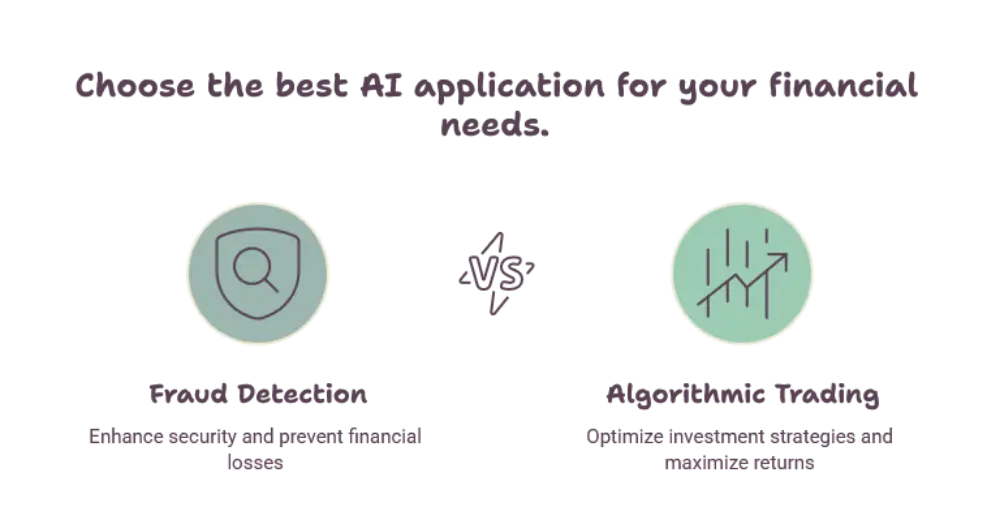
Artificial intelligence is not limited to one corner of the financial industry. It touches nearly every function, from customer service to compliance.
Fraud Detection and Risk Management
One of the strongest use cases for AI in finance is fraud detection. Machine learning models can analyze transaction patterns in real time and flag anything unusual almost instantly. This allows banks to stop fraudulent activity before it causes serious damage, rather than discovering it after the fact.
Risk management teams also use predictive models to assess credit risk, market volatility, and operational threats. These models continuously learn from new data, which makes them more accurate over time compared to traditional statistical methods.
Algorithmic Trading
Algorithmic trading uses AI driven models to analyze market data and execute trades based on defined strategies. These systems can process news, price movements, and historical trends far faster than a human trader ever could.
This speed and precision help firms react to market changes almost instantly, reducing emotional decision making and improving consistency in trading strategies.
Personalized Banking and Customer Service
AI powered chatbots and virtual assistants have transformed customer service in banking. These tools can answer questions, help with transactions, and provide account insights around the clock without long wait times.
Beyond chat support, AI also enables personalized financial advice. analyzing spending habits and financial goals, intelligent systems can recommend budgeting tips, savings plans, or investment options tailored to each individual.
Credit Scoring and Loan Approval
Traditional credit scoring often relies on a narrow set of factors. AI expands this by analyzing alternative data such as spending behavior, payment history, and even employment stability to create a more complete financial profile.
This approach can help lenders make fairer and faster decisions, and it can also give more people access to credit who might otherwise be overlooked by conventional scoring systems.
Benefits of AI in Finance
The advantages of adopting AI in finance go well beyond simple automation.
- Faster Decision Making AI systems can process massive datasets in seconds, allowing institutions to make quicker and more informed decisions.
- Improved Accuracy Machine learning models reduce human error in tasks like data entry, calculations, and pattern recognition.
- Enhanced Customer Experience Personalized recommendations and instant support make financial services more accessible and user friendly.
- Stronger Security Continuous monitoring helps identify threats early, protecting both institutions and customers from fraud.
- Scalability AI systems can handle growing volumes of transactions and customer interactions without a proportional increase in manual effort.
Challenges and Considerations
Despite its promise, AI in finance comes with real challenges that organizations must carefully manage.
Data Privacy and Security
Financial data is highly sensitive, and AI systems require large amounts of it to function effectively. Institutions must invest heavily in cybersecurity and data governance to ensure this information stays protected from breaches or misuse.
Regulatory Compliance
Financial services operate under strict regulations, and AI driven decisions must remain transparent and explainable. Regulators increasingly expect institutions to demonstrate how their AI models reach conclusions, especially in areas like lending and risk assessment.
Human Oversight
While AI can process data at incredible speed, human judgment remains essential. Financial institutions need skilled professionals who can interpret AI outputs, catch anomalies, and make final calls in complex or sensitive situations.
The Future of AI in Finance
Looking ahead, AI in finance is expected to become even more integrated into everyday financial operations. Predictive analytics will likely become more precise, chatbots will handle increasingly complex conversations, and fraud detection systems will continue to evolve to catch new types of threats.
We may also see greater collaboration between human experts and AI systems, where technology handles data heavy tasks while people focus on strategy, relationship building, and ethical oversight. As machine learning models continue to improve, the financial industry will likely become more efficient, more personalized, and more resilient.
Conclusion
AI in finance is no longer an experimental concept. It is actively reshaping how banks operate, how risks are managed, and how customers experience financial services. From fraud detection to personalized banking, the applications are wide ranging and continue to expand.
As with any transformative technology, success depends on balancing innovation with responsibility. Institutions that invest in strong data practices, transparent AI models, and skilled human oversight will be best positioned to benefit from this shift. The financial world is changing, and AI is at the center of that change.
Frequently Asked Questions
What is AI in finance?
AI in finance refers to the use of machine learning and data driven technology to automate financial tasks such as fraud detection, trading, and customer service.
How is AI used in fraud detection?
AI analyzes transaction patterns in real time to identify unusual activity and flag potential fraud before it causes significant harm.
Can AI improve loan approval processes?
Yes, AI can analyze a wider range of data points to assess creditworthiness, helping lenders make faster and more informed decisions.
Is AI replacing human jobs in finance?
AI is automating repetitive tasks, but human expertise remains essential for strategy, judgment, and oversight in complex financial decisions.
What are the risks of using AI in finance?
Key risks include data privacy concerns, regulatory compliance challenges, and the need for transparency in how AI models make decisions.