Quantum computing explained simply means understanding how machines can process information using the strange rules of quantum physics instead of traditional binary code. Unlike classical computers that rely on bits of zeros and ones, quantum computers use quantum bits that can exist in multiple states at once. This gives them the potential to solve certain problems far faster than any computer we use today. In this post, we will break down what quantum computing really means, how it works, and why it is becoming such an important topic in technology.
What Is Quantum Computing
Quantum computing is a type of computing that uses the principles of quantum mechanics to process information. Quantum mechanics is the branch of physics that studies how particles behave at extremely small scales, such as atoms and photons.
Instead of using bits like classical computers, quantum computers use quantum bits, commonly known as qubits. These qubits behave in ways that seem impossible in everyday life, which is what gives quantum computers their unique power.
Classical Computing vs Quantum Computing
Classical computers store information as bits. Each bit is either a zero or a one. Every calculation a classical computer performs is built from combinations of these two values.
Quantum computers work differently. A qubit can represent a zero, a one, or both at the same time. This ability allows quantum computers to explore many possibilities simultaneously rather than one at a time.
How Does Quantum Computing Work
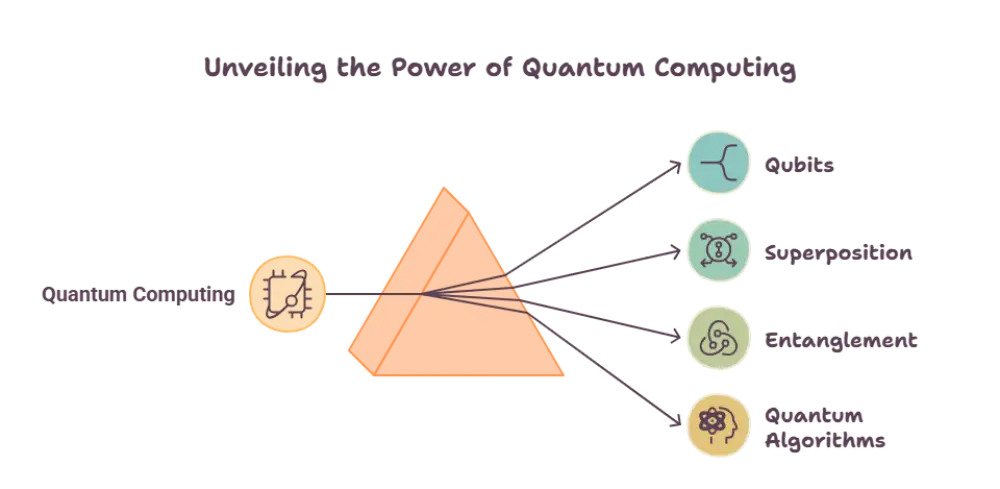
To understand quantum computing, it helps to look at a few key concepts that make it different from anything in traditional computing.
Superposition
Superposition is the idea that a qubit can exist in multiple states at once. Instead of being strictly zero or one, a qubit can be a mix of both until it is measured. This allows quantum computers to process a huge number of possibilities at the same time.
Entanglement
Entanglement is a phenomenon where two qubits become linked in such a way that the state of one instantly affects the state of the other, no matter how far apart they are. This connection allows quantum computers to perform complex calculations with incredible efficiency.
Quantum Interference
Quantum interference is used to guide qubits toward the correct answer. carefully controlling how qubits interact, scientists can increase the chances of getting a useful result and reduce the chances of getting an incorrect one.
Why Quantum Computing Matters
Quantum computing is not just a scientific curiosity. It has the potential to transform entire industries by solving problems that are currently impossible or impractical for classical computers.
Faster Problem Solving
Certain problems, such as simulating molecules or optimizing complex systems, require enormous computing power. Quantum computers can handle these tasks more efficiently because they can process many possibilities in parallel.
Advancements in Science
Fields like chemistry, physics, and medicine could benefit greatly from quantum computing. Researchers could simulate molecular structures with high accuracy, which could lead to breakthroughs in drug discovery and material science.
Improved Security Research
Quantum computing is also pushing forward the development of new encryption methods. As quantum computers grow more powerful, researchers are working on stronger security systems that can withstand future quantum capabilities.
Real World Applications of Quantum Computing
Quantum computing is still an emerging technology, but its potential applications are already being explored across several industries.
Healthcare and Drug Discovery
Quantum computers can simulate complex molecules, which could help researchers understand diseases at a deeper level and speed up the development of new treatments.
Logistics and Optimization
Industries that rely on complex scheduling and routing, such as transportation and manufacturing, could use quantum computing to find more efficient solutions to complicated problems.
Artificial Intelligence
Quantum computing could enhance machine learning by processing large datasets more efficiently, helping AI systems learn patterns faster and with greater accuracy.
Climate and Environmental Modeling
Simulating climate systems requires massive computational power. Quantum computing could help scientists build more accurate models to better understand and predict environmental changes.
Challenges Facing Quantum Computing
Despite its potential, quantum computing still faces several challenges that researchers are working to overcome.
Maintaining Qubit Stability
Qubits are extremely sensitive to their environment. Even small changes in temperature or electromagnetic interference can cause errors, a problem known as decoherence.
Error Correction
Because qubits are prone to errors, developing reliable quantum error correction methods is one of the biggest challenges in the field.
Scalability
Building quantum computers with a large number of stable qubits is difficult. Researchers are continuously working on new methods to scale up quantum systems while keeping them reliable.
The Future of Quantum Computing
Quantum computing is still in its early stages, but progress is happening quickly. Scientists and engineers around the world are working to make quantum computers more stable, more powerful, and more accessible for practical use.
As research continues, we may see quantum computing play a major role in solving some of the world’s most complex problems, from medical research to climate modeling and beyond. While it may not replace classical computers entirely, it is expected to work alongside them, handling specialized tasks that classical systems struggle with.
Conclusion
Quantum computing explained in simple terms comes down to using the unusual behavior of particles at the smallest scales to process information in powerful new ways. Through concepts like superposition and entanglement, quantum computers have the potential to solve problems that are currently out of reach for classical computers. While there are still challenges to overcome, the future of quantum computing looks promising, and its impact could be felt across science, healthcare, technology, and beyond.
Frequently Asked Questions
What is quantum computing in simple terms?
Quantum computing is a type of computing that uses the principles of quantum physics to process information using qubits instead of traditional bits, allowing it to solve certain complex problems more efficiently.
How is quantum computing different from classical computing?
Classical computers use bits that are either zero or one, while quantum computers use qubits that can exist in multiple states at once, allowing them to process many possibilities simultaneously.
What are qubits in quantum computing?
Qubits are the basic units of information in quantum computing. Unlike classical bits, qubits can represent zero, one, or a combination of both at the same time due to superposition.
What are the real world uses of quantum computing?
Quantum computing has potential applications in healthcare, drug discovery, logistics, artificial intelligence, and climate modeling, where it can help solve complex problems more efficiently.
Why is quantum computing considered difficult to build?
Quantum computing is challenging because qubits are highly sensitive to their environment, which can cause errors. Researchers are still working on improving qubit stability, error correction, and scalability.