In today’s hyper-connected global economy, businesses that thrive are those that master the art and science of supply chain management. Whether you run a small manufacturing unit or a multinational enterprise, how efficiently you move products from raw materials to the end customer determines your competitive edge, profitability, and customer satisfaction.
Supply chain management is not just a logistical function. It is a strategic business discipline that touches every corner of an organization, from procurement and production to warehousing, distribution, and customer delivery. Understanding it deeply can transform how a business operates, responds to disruptions, and scales sustainably.
This guide walks you through everything you need to know about supply chain management, including its core components, key strategies, modern challenges, and best practices that actually work.
What Is Supply Chain Management?
At its core, supply chain management (SCM) refers to the oversight and coordination of all activities involved in sourcing, procurement, production, and delivery of products and services. It encompasses the entire journey of a product, from the moment raw materials are extracted or sourced to the point a finished product reaches the final consumer.
Supply chain management, SCM involves the active management of supply chain activities to maximize customer value and achieve a sustainable competitive advantage. It represents a conscious effort by supply chain firms to develop and run supply chains in the most effective and efficient way possible.
The primary goal is simple: deliver the right product, at the right time, in the right quantity, to the right place, at the lowest possible cost. But achieving this requires sophisticated coordination across multiple stakeholders, systems, and geographies.
Key Components of Supply Chain Management
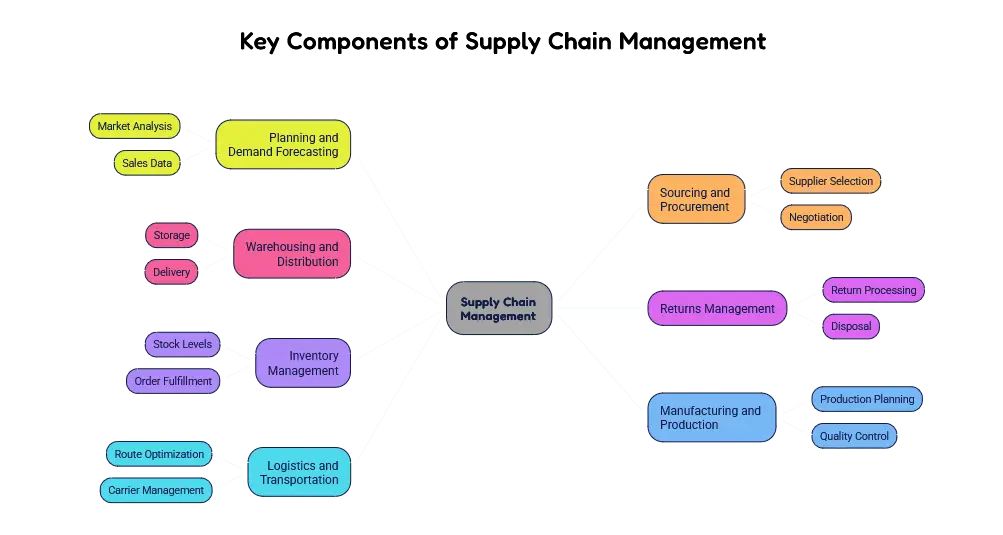
Understanding supply chain management means understanding its building blocks. Each component plays a vital role in creating a seamless flow of goods and information.
Planning and Demand Forecasting
Everything starts with planning. Businesses must anticipate what customers will need, how much they will need, and when they will need it. Accurate demand forecasting helps companies avoid overproduction or stockouts, both of which are costly. Modern planning tools powered by data analytics and artificial intelligence have made demand forecasting significantly more precise.
Sourcing and Procurement
Once demand is understood, sourcing kicks in. This involves identifying and selecting suppliers who can provide the necessary raw materials or components at the right quality and cost. Strong supplier relationships are foundational to a resilient supply chain. Procurement teams negotiate contracts, manage vendor performance, and ensure compliance with quality standards.
Manufacturing and Production
This is where inputs are transformed into finished goods. Efficient manufacturing processes minimize waste, reduce lead times, and ensure consistent product quality. Lean manufacturing principles, widely studied in business and engineering programs at institutions like the MIT Sloan School of Management, emphasize eliminating waste while maintaining high output standards.
Inventory Management
Holding too much inventory ties up capital. Holding too little leads to stockouts and lost sales. Effective inventory management finds the sweet spot. Techniques like Just-in-Time (JIT) inventory, safety stock calculations, and ABC analysis help businesses maintain optimal stock levels across their distribution networks.
Logistics and Transportation
Moving goods efficiently from one point to another requires a well-coordinated logistics network. This includes road freight, ocean shipping, air cargo, and last-mile delivery. Transportation decisions directly impact cost, delivery speed, and carbon footprint, making logistics optimization a major priority for modern supply chain managers.
Warehousing and Distribution
Warehouses are the nodes of a supply chain network. Strategic placement of warehouses reduces shipping distances and speeds up order fulfillment. Modern fulfillment centers use automation, robotics, and warehouse management systems (WMS) to process thousands of orders daily with high accuracy.
Returns Management (Reverse Logistics)
A complete supply chain does not end at delivery. Returns management, also called reverse logistics, handles the flow of products coming back from customers due to defects, dissatisfaction, or end-of-life recycling. A smooth returns process enhances customer trust and recovers residual product value.
Why Supply Chain Management Matters
The importance of supply chain management cannot be overstated. A well-run supply chain directly impacts a company’s bottom line and its ability to serve customers. Research published through academic institutions including Penn State’s Supply Chain Management programs has consistently shown that companies with superior supply chain capabilities outperform their peers in profitability and growth.
Here is why SCM is a business-critical function:
- Cost Reduction: Efficient supply chains eliminate redundant processes, reduce waste, and optimize procurement spend. Even a small improvement in supply chain efficiency can translate into significant savings at scale.
- Customer Satisfaction: On-time delivery, accurate orders, and responsive customer service are all downstream results of an effective supply chain. Satisfied customers become repeat buyers and brand advocates.
- Risk Mitigation: Supply chains are exposed to a wide range of risks, including geopolitical disruptions, natural disasters, supplier failures, and demand volatility. Strong SCM practices include contingency planning and supplier diversification to absorb shocks.
- Competitive Advantage: Companies that deliver faster, cheaper, and more reliably than their competitors win market share. Supply chain excellence is often a decisive differentiator in crowded markets.
- Sustainability: Modern businesses are under growing pressure to reduce their environmental footprint. Supply chain management plays a central role in achieving sustainability goals through greener transportation, ethical sourcing, and waste reduction.
Modern Challenges in Supply Chain Management
The global supply chain landscape has grown increasingly complex and volatile. Several key challenges define the modern SCM environment.
Globalization and Complexity
Sourcing from multiple countries creates a longer, more complex supply chain with more points of failure. Currency fluctuations, trade policies, and cross-border regulations add additional layers of difficulty.
Supply Chain Disruptions
The COVID-19 pandemic exposed how fragile global supply chains can be. Port congestions, raw material shortages, and transportation bottlenecks caused cascading delays across industries worldwide. Companies are now rethinking their reliance on single-source suppliers.
Digital Transformation
The transition from paper-based and manual processes to digital platforms is transforming SCM. Cloud-based supply chain platforms, IoT sensors, blockchain for traceability, and AI-powered analytics are becoming standard tools. However, integrating these technologies across complex partner ecosystems remains a significant challenge.
Sustainability Pressures
Regulators, investors, and consumers are demanding more responsible supply chains. Companies must track and reduce carbon emissions, eliminate unethical labor practices, and adopt circular economy principles. Balancing cost efficiency with sustainability is one of the defining challenges of modern SCM.
Talent Shortage
Skilled supply chain professionals are in high demand globally. As supply chains grow more technology-driven, the need for people who understand both operations and data analytics has intensified. Universities and professional certifications are working to address this gap.
Best Practices for Effective Supply Chain Management
Businesses that excel at supply chain management share a common set of practices. Adopting these principles can significantly improve your operational outcomes.
Build Strong Supplier Relationships: Treat suppliers as strategic partners, not just vendors. Regular communication, fair contracts, and collaborative problem-solving create a more resilient supply chain.
Invest in Visibility: Real-time visibility into inventory levels, shipment status, and supplier performance allows managers to make faster, better-informed decisions. Visibility platforms that aggregate data across the supply chain are invaluable.
Embrace Technology Thoughtfully: Technology should solve a problem, not create complexity. Start with foundational tools like a solid ERP system and warehouse management system before layering in advanced capabilities like AI or blockchain.
Diversify Your Supplier Base: Relying on a single supplier for critical components is a risk. Building a diversified supplier portfolio with redundancies for key inputs reduces vulnerability to disruptions.
Focus on Continuous Improvement: The best supply chains are never static. Regular performance reviews, benchmarking against industry standards, and a culture of continuous improvement keep the supply chain optimized as business conditions evolve.
Align Supply Chain with Business Strategy: Supply chain decisions must be made in the context of broader business goals. Whether the strategy is low-cost leadership, fast delivery, or premium quality, the supply chain must be designed to support it.
The Future of Supply Chain Management
The future of SCM will be shaped by technology, sustainability, and resilience. Artificial intelligence will make demand forecasting more accurate and dynamic. Automation in warehouses and transportation will reduce labor dependency and improve speed. Blockchain will bring greater transparency and trust to multi-party supply chains.
Research from MIT’s Center for Transportation and Logistics suggests that supply chains of the future will be more agile, more data-driven, and more closely integrated with broader business ecosystems. Companies that invest now in building flexible, technology-enabled supply chains will be far better positioned to navigate whatever disruptions lie ahead.
Sustainability will also move from an optional consideration to a core requirement. Green logistics, ethical sourcing standards, and circular supply chains will become table stakes rather than differentiators.
Conclusion
Supply chain management is one of the most powerful levers a business has to improve performance, control costs, and delight customers. It is a discipline that rewards investment, strategic thinking, and continuous learning.
From planning and procurement to logistics and returns, every link in the supply chain represents an opportunity to create value or lose it. Businesses that treat their supply chains as strategic assets and invest in the right people, processes, and technologies will consistently outperform those that treat it as a back-office function.
Whether you are just starting to formalize your supply chain processes or looking to optimize a mature operation, the principles outlined in this guide provide a strong foundation for building a supply chain that truly drives business success.
FAQs
What is the main purpose of supply chain management?
The main purpose of supply chain management is to coordinate and streamline all activities involved in sourcing, production, and delivery of goods so that the right product reaches the right customer at the right time, at the lowest possible cost. It helps businesses improve efficiency, reduce waste, and enhance customer satisfaction across every stage of the product journey.
What are the five basic components of supply chain management?
The five basic components of supply chain management are planning, sourcing, manufacturing, delivery, and returns. Planning involves demand forecasting and resource allocation. Sourcing covers supplier selection and procurement. Manufacturing transforms raw materials into finished products. Delivery manages logistics and distribution. Returns, also known as reverse logistics, handles product recalls, refunds, and recycling processes.
How does supply chain management benefit a business?
Supply chain management benefits a business by reducing operational costs, improving delivery speed, minimizing inventory waste, and strengthening supplier relationships. It also helps companies respond faster to market changes and disruptions, maintain consistent product quality, and build stronger customer loyalty through reliable and timely order fulfillment.
What is the difference between supply chain management and logistics?
Logistics is a subset of supply chain management. Logistics focuses specifically on the transportation, warehousing, and movement of goods from one point to another. Supply chain management, on the other hand, covers a much broader scope that includes procurement, production planning, supplier management, demand forecasting, and customer service in addition to logistics functions.
What are the biggest challenges in supply chain management today?
The biggest challenges in supply chain management today include global disruptions such as pandemics and geopolitical conflicts, rising transportation costs, supplier reliability issues, increasing pressure to adopt sustainable practices, and the rapid pace of digital transformation. Companies must also manage growing consumer expectations for faster delivery and greater product transparency throughout the supply chain.