
You stand at a precipice, gazing out at the vast, ever-shifting landscape of modern business. The air hums with the incessant thrum of data, and the ground beneath your feet vibrates with the relentless pace of innovation. In this brave new world, one truth resounds above all others: the digital transformation isn’t just a trend; it’s the very heartbeat of progress, particularly when it comes to service. You, the astute business leader, the discerning customer, the innovative employee, are witnessing and, indeed, participating in a revolution. This isn’t just about integrating a few new technologies; it’s about fundamentally reshaping how you perceive, deliver, and experience service.
You might have heard the term “digital transformation” bandied about, sometimes as a buzzword, other times as a strategic imperative. But what does it truly signify in the context of service? It’s far more than simply moving your customer support from phone calls to email. It’s a holistic, fundamental reimagining of every touchpoint, every interaction, and every data point that constitutes the customer journey and the internal processes that support it. You’re no longer just reacting to customer needs; you’re anticipating them, shaping them, and in many cases, exceeding them before they’re even fully articulated.
- More Than Just Automation: A New Service Philosophy
- The Data Deluge as Your Guiding Star
- Empowering the Service Agent: From Call Center to Command Center
- The Pillars of Modern Service: Key Technologies Driving the Revolution
- Cloud Computing: The Scalable Backbone of Modern Service
- Omnichannel Experience: Meeting Customers Where They Are
- Tangible Benefits: What Digital Transformation Delivers to Your Business
- Boosting Operational Efficiency and Cost Savings: Smart Business, Better Service
- Overcoming Obstacles: Your Journey to Digital Service Excellence
- FAQs
More Than Just Automation: A New Service Philosophy
Think for a moment about your own experiences. When you interact with a company today, what do you expect? You expect speed, personalization, and seamlessness. You expect to be understood, not just as a transaction, but as an individual with unique needs and preferences. This expectation is precisely what digital transformation empowers you to deliver. It shifts your service philosophy from being reactive and transactional to proactive, empathetic, and relationship-driven. You’re not just fixing problems; you’re building loyalty, trust, and advocacy.
The Data Deluge as Your Guiding Star
You’re swimming in data, whether you realize it or not. Every click, every query, every purchase, every social media mention – it all contributes to a vast ocean of information. Digital transformation equips you with the tools to navigate this deluge, transforming raw data into actionable insights. You move beyond anecdotal evidence and gut feelings, relying instead on concrete data points to inform your service strategies. This allows you to identify pain points before they escalate, personalize experiences at scale, and even predict future customer behavior.
Empowering the Service Agent: From Call Center to Command Center
For too long, the image of a service agent was synonymous with a frustrated individual tied to a phone, limited by siloed information and rigid scripts. Digital transformation liberates these vital frontline employees. You’re providing them with integrated platforms, real-time access to customer histories, and AI-powered tools that augment their capabilities. This transforms them from mere problem-solvers into true customer advocates, equipped to deliver exceptional, personalized service. You’re investing in their experience so they can elevate your customers’ experience.
The Pillars of Modern Service: Key Technologies Driving the Revolution
You understand the “why,” but what about the “how”? The digital transformation of service is built upon a foundation of interconnected technologies, each playing a crucial role in shaping the new service landscape. Ignoring any of these pillars would be like trying to build a magnificent edifice on a
shaky foundation.
Artificial Intelligence and Machine Learning: Your Intelligent Co-Pilots
You’re likely already interacting with AI in your daily life, perhaps without even realizing it. In service, AI and ML are not here to replace human interaction but to enhance it. Think of them as intelligent co-pilots, working alongside your human agents to streamline processes and elevate experiences.
Conversational AI and Chatbots: Always On, Always Ready
You’ve probably encountered chatbots on websites, guiding you through FAQs or helping you track an order. These aren’t just glorified automated phone trees; modern conversational AI utilizes natural language processing (NLP) to understand complex queries, provide personalized responses, and even intelligently escalate issues to human agents when necessary. This means your customers receive instant support, 24/7, freeing up your human agents for more complex, high-value interactions. You’re providing immediate gratification and reducing wait times, a critical factor in customer satisfaction.
Predictive Analytics: Anticipating Needs Before They Arise
Imagine knowing what your customer needs before they even ask. This is the power of predictive analytics, driven by ML. analyzing past interactions, purchase history, and behavioral patterns, you can proactively offer relevant information, suggest solutions, or even reach out to prevent potential issues. You’re moving from a reactive “fix-it” model to a proactive “prevent-it” model, delighting customers with your foresight.
Intelligent Routing and Agent Assist: Optimizing Every Interaction
No one likes being bounced from department to department. Intelligent routing, powered by AI, ensures that customer inquiries are directed to the most appropriate agent or department on the first attempt. Furthermore, agent assist tools provide real-time information, scripts, and even suggested responses to your human agents, ensuring consistency, efficiency, and higher first-contact resolution rates. You’re empowering your team to be more effective and your customers to get the right answer, faster.
Cloud Computing: The Scalable Backbone of Modern Service
You wouldn’t try to run a global operation off a single server in your basement. Cloud computing provides the flexible, scalable, and secure infrastructure that underpins all aspects of digital service transformation. It’s the circulatory system of your new service ecosystem.
Scalability and Flexibility: Adapting to Your Needs
Imagine a sudden surge in customer inquiries during a product launch or a crisis. With cloud computing, you can dynamically scale your resources up or down, ensuring uninterrupted service without massive upfront investment in hardware. You’re always prepared for the unexpected, maintaining a consistent level of service regardless of fluctuating demands.
Accessibility and Collaboration: Breaking Down Silos
Cloud-based platforms mean your service agents, sales team, and even R&D can access the same customer information from anywhere, at any time. This breaks down departmental silos, fostering seamless collaboration and ensuring a unified view of the customer. You’re eliminating information bottlenecks and promoting a more cohesive customer experience.
Enhanced Security and Reliability: Protecting Your Data
You operate in a world where data security is paramount. Cloud providers invest heavily in robust security measures and disaster recovery protocols, offering a level of protection that would be financially prohibitive for most individual businesses. You’re entrusting your valuable customer data to experts, ensuring its safety and the continuity of your service operations.
Omnichannel Experience: Meeting Customers Where They Are
You live in a multi-channel world. Your customers expect to interact with you on their preferred platform, whether it’s social media, email, phone, chat, or a mobile app, and they expect the experience to be seamless as they switch between channels. This is the essence of an omnichannel approach.
Consistent Messaging and Context Across Channels
Think about the frustration of repeating your issue every time you switch from chat to phone. An omnichannel strategy ensures that all your customer interaction data is consolidated, providing a complete history regardless of the channel used. Your agents have context, and your customers feel understood, without having to reiterate their story. You’re creating a cohesive narrative for each customer interaction.
Self-Service Portals and Knowledge Bases: Empowering the Customer
You recognize that many customers prefer to find solutions themselves. Robust self-service portals, comprehensive knowledge bases, and intuitive FAQs empower your customers to resolve common issues independently. This not only improves customer satisfaction by providing instant answers but also reduces the burden on your contact centers, allowing your agents to focus on more complex cases. You’re giving your customers control and convenience.
Proactive Engagement: Reaching Out Before They Reach Out
Beyond reacting to inquiries, omnichannel allows you to proactively engage with customers on their preferred channels. This could be sending personalized product recommendations via email, offering proactive support through in-app messages, or even addressing feedback on social media. You’re not just waiting for problems; you’re actively cultivating relationships and preventing issues.
Tangible Benefits: What Digital Transformation Delivers to Your Business
You’ve explored the technologies and the philosophical shift. Now, let’s turn our attention to the tangible results you can expect when you fully embrace digital transformation in service. These aren’t just abstract ideas; they’re measurable improvements that directly impact your bottom line and your competitive standing.
Elevating Customer Satisfaction and Loyalty: The Heart of Your Business
Ultimately, the goal of any service improvement is to delight your customers. Digital transformation provides the tools to do just that, fostering a level of satisfaction that translates directly into enduring loyalty.
Hyper-Personalization: Treating Every Customer as Unique
Gone are the days of one-size-fits-all service. With data-driven insights and AI, you can deliver hyper-personalized experiences that make customers feel truly valued. From tailored recommendations to proactive offers based on their history and preferences, you’re building deeper connections and fostering a sense of individual recognition. You’re moving beyond generic interactions to truly bespoke service.
Reduced Resolution Times: Efficiency That Translates to Delight
No one wants to wait. Digital tools streamline processes, provide agents with instant information, and empower customers with self-service options, all contributing to significantly faster issue resolution. This efficiency directly impacts customer satisfaction, reducing frustration and creating a more positive overall experience. You’re valuing their time as much as they do.
Enhanced Customer Journeys: Smooth and Seamless Interactions
From the first point of contact to post-purchase support, digital transformation allows you to map, optimize, and personalize every step of the customer journey. You’re identifying pain points, smoothing out transitions between channels, and creating an effortless experience that consistently exceeds expectations. You’re crafting a beautiful symphony of interactions, rather than a cacophony of disconnected touchpoints.
Boosting Operational Efficiency and Cost Savings: Smart Business, Better Service
While enhancing the customer experience is paramount, digital transformation also brings significant benefits to your internal operations, leading to greater efficiency and substantial cost savings. You’re not just spending smarter; you’re working smarter.
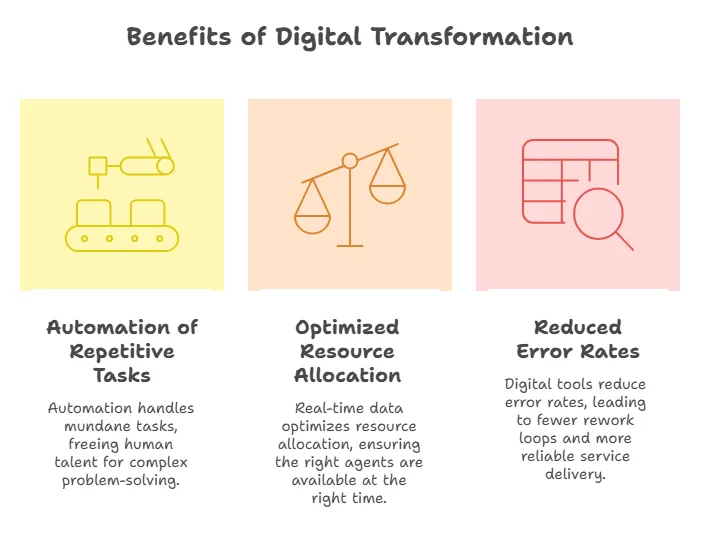
Automation of Repetitive Tasks: Freeing Up Your Human Talent
Think of all the mundane, repetitive tasks that consume your service agents’ time – password resets, tracking orders, answering identical FAQs. Automation, through chatbots and RPA (Robotic Process Automation), handles these tasks with speed and accuracy, freeing your human team to focus on complex problem-solving, empathetic engagement, and value-added interactions. You’re allowing your human talent to shine where it matters most.
Optimized Resource Allocation: Doing More with Less
With real-time data and predictive analytics, you can better anticipate call volumes, staffing needs, and common issues. This allows you to optimize your resource allocation, ensuring you have the right number of agents with the right skills available at the right time, without overspending on staffing during slow periods. You’re fine-tuning your operations for maximum impact.
Reduced Error Rates: Precision and Accuracy
Human error is an inevitable part of any manual process. Digital tools, with their inherent precision and consistency, significantly reduce error rates in data entry, information retrieval, and process execution. This leads to fewer rework loops, less customer frustration, and a more reliable service delivery. You’re building a foundation of accuracy and trust.
Overcoming Obstacles: Your Journey to Digital Service Excellence
You’re convinced of the benefits, but the path to digital transformation isn’t without its challenges. You’ll encounter hurdles, but by anticipating them and developing proactive strategies, you can navigate them successfully.
The Culture Shift: Embracing Change from Within
Technology is only half the battle. The most significant obstacle you might face is cultural inertia – resistance to change within your organization.
Leading by Example: Championing the Vision
As a leader, your enthusiasm and commitment are infectious. You must actively champion the vision of a digitally transformed service, articulating its benefits to every level of your organization. Transparency and clear communication are key to garnering buy-in. You must be the beacon guiding your team through the transformation.
Training and Upskilling: Empowering Your Workforce
Fear of the unknown is a powerful deterrent. Invest heavily in comprehensive training programs that equip your employees with the skills and confidence to utilize new technologies effectively. Emphasize that digital tools are designed to augment their capabilities, not replace them. You’re investing in your people, helping them adapt and thrive in the new environment.
Fostering a Culture of Experimentation: Learning and Adapting
Digital transformation is an iterative process. Encourage a culture where experimentation is welcomed, failures are seen as learning opportunities, and continuous improvement is the norm. You’re not aiming for perfection from day one; you’re aiming for progress and continuous evolution.
Data Security and Privacy: Building Trust in a Connected World
You’re collecting vast amounts of customer data, and with that comes a profound responsibility. Ensuring the security and privacy of this data is not merely a compliance requirement; it’s a cornerstone of customer trust.
Robust Security Protocols: Protecting Your Digital Assets
Implement stringent security protocols, including encryption, access controls, and regular audits, across all your digital service platforms. Adhere to all relevant data privacy regulations (e.g., GDPR, CCPA) and communicate your commitment to data protection clearly to your customers. You’re building a fortress around their information.
Transparency and Consent: Empowering Your Customers
Be transparent with your customers about how their data is collected, used, and protected. Provide them with clear options for managing their privacy settings and exercising their data rights. Trust is built on transparency, and you’re actively fostering that trust.
Regular Audits and Updates: Staying Ahead of Threats
The threat landscape is constantly evolving. Conduct regular security audits, stay informed about emerging threats, and ensure your systems and protocols are continuously updated to counteract new vulnerabilities. You’re playing an ongoing game of chess, always anticipating the next move.
Your Future in Service: A Continuous Journey
| Metrics | 2018 | 2019 | 2020 |
|---|---|---|---|
| Percentage of digitalized processes | 35% | 45% | 55% |
| Customer satisfaction rate | 75% | 80% | 85% |
| Investment in digital technologies (in millions) | 50 | 70 | 90 |
You stand on the cusp of an incredible era for service. Digital transformation isn’t a destination; it’s a continuous journey of innovation, adaptation, and improvement. embracing the technologies, fostering the right culture, and prioritizing the customer above all else, you will not just keep pace with the revolution; you will lead it. Your commitment to leveraging digital transformation for service excellence will define your success, deepen your customer relationships, and secure your position as a leader in a rapidly evolving market. The future of service is digital, and you are its architect.
FAQs
What is digital transformation in the service industry?
Digital transformation in the service industry refers to the integration of digital technology into all areas of a business, fundamentally changing how it operates and delivers value to customers. This can include the use of digital tools and technologies to improve customer experience, streamline operations, and enhance overall business performance.
What are some examples of digital transformation in the service industry?
Examples of digital transformation in the service industry include the implementation of customer relationship management (CRM) systems, adoption of cloud-based technologies for data storage and management, use of artificial intelligence for customer service and support, and development of mobile applications for service delivery.
What are the benefits of digital transformation in the service industry?
The benefits of digital transformation in the service industry include improved efficiency and productivity, enhanced customer experience, better data management and analysis, increased agility and innovation, and the ability to adapt to changing market demands and customer preferences.
What are the challenges of digital transformation in the service industry?
Challenges of digital transformation in the service industry can include resistance to change from employees, integration of new technologies with existing systems, data security and privacy concerns, and the need for ongoing investment in technology and training.
How can businesses in the service industry start their digital transformation journey?
Businesses in the service industry can start their digital transformation journey by conducting a thorough assessment of their current processes and identifying areas for improvement through digital technologies. They can then develop a clear digital transformation strategy, invest in the right technologies, and provide training and support for employees to adapt to the changes.