

The global manufacturing landscape is undergoing a massive shift. The days of relying entirely on manual labor and fragmented mechanical systems are fading. Today, businesses aiming to stay competitive are turning to industrial automation solutions to streamline their workflows, maximize output, and dramatically reduce operational errors.
Whether you operate a small-scale assembly plant or manage a massive global supply chain, integrating smart automation is no longer a luxury. It is a baseline requirement for survival and growth.
This comprehensive guide explores what industrial automation solutions are, the core technologies driving them, the tangible benefits they offer, and how you can prepare your business for the future of smart manufacturing.
- What Are Industrial Automation Solutions?
- The Core Pillars of Industrial Automation Technology
- Key Benefits of Implementing Industrial Automation Solutions
- Key Industries Harnessing Automation Today
- Major Trends Shaping the Future of Industrial Automation
- Key Considerations for a Successful Automation Journey
- Conclusion
- FAQs
What Are Industrial Automation Solutions?
At its core, industrial automation refers to the use of control systems, advanced software, and robotics to operate machinery and manage industrial processes with minimal human intervention.
Instead of human operators manually controlling every variable, automation solutions use data-driven feedback loops to make real-time adjustments. These systems seamlessly bridge the gap between physical machinery and digital intelligence, creating a cohesive ecosystem where data drives physical action.
The Evolution of the Factory Floor
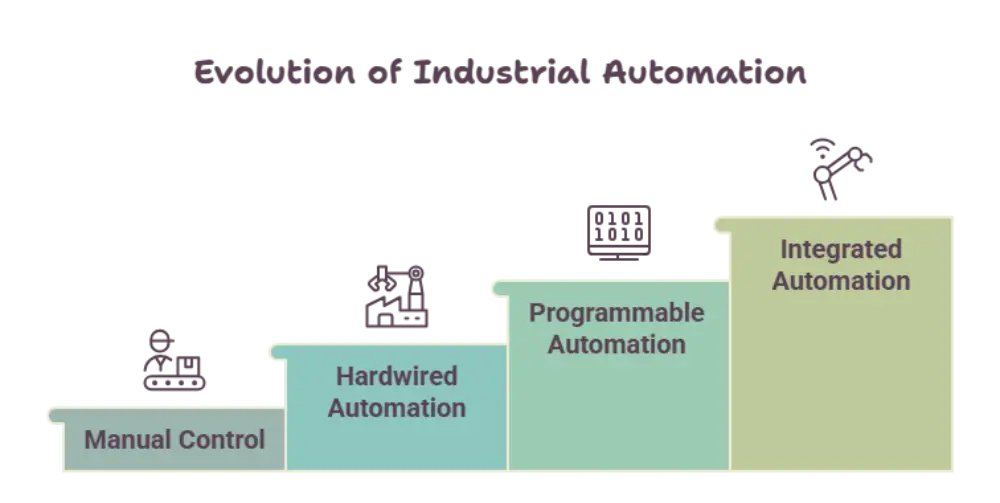
Industrial automation did not happen overnight. It evolved across distinct stages:
- Manual Control: Humans performed every task using basic tools.
- Hardwired Automation: Machinery was controlled by rigid, physical wiring and relays. Changing a process required rewiring the entire system.
- Programmable Automation: The introduction of computers allowed operators to change software code rather than physical hardware to modify tasks.
- Integrated Automation: Today’s gold standard, where entire factories are linked through cloud networks, artificial intelligence, and IoT devices, requiring minimal human oversight.
The Core Pillars of Industrial Automation Technology
To understand how these solutions work, it helps to look at the foundational technologies that power modern automated systems. These components work together like a human body, combining brains, nerves, and muscles.
1. Programmable Logic Controllers (PLCs)
Consider the PLC the “brain” of the factory floor. A PLC is a ruggedized industrial computer designed to withstand harsh environments like extreme heat, dust, and moisture. It continuously monitors inputs from sensors, processes that data based on custom programming, and sends commands to execute specific outputs.
2. Supervisory Control and Data Acquisition (SCADA)
If PLCs are the individual brains of specific machines, SCADA is the overarching nervous system. SCADA systems are software architectures used to monitor and control entire industrial sites. They gather real-time data from various machines, display it on user-friendly dashboards, and allow operators to intervene when necessary.
3. Distributed Control Systems (DCS)
For massive, continuous manufacturing processes like oil refining or chemical production, a DCS is preferred. Instead of a centralized controller, a DCS distributes control loops across an entire plant. This ensures that if one controller fails, the rest of the plant keeps running safely.
4. Human Machine Interfaces (HMIs)
An HMI is the screen or dashboard that connects human operators to the machines. Modern HMIs are highly intuitive, featuring touchscreens and visual graphics that allow workers to monitor system health, adjust settings, and troubleshoot errors instantly.
5. Robotics and Actuators
Robotics represent the muscles of industrial automation solutions. From heavy-duty articulated robotic arms used in automotive welding to delicate collaborative robots (cobots) designed to work safely alongside humans, these machines handle repetitive, precise, or dangerous physical tasks.
Key Benefits of Implementing Industrial Automation Solutions
Investing in automation is a major strategic decision. Businesses that take the leap consistently see transformative returns across several key metrics.
Unmatched Operational Efficiency
Human workers require breaks, shifts, and vacations. Automated systems can operate twenty-four hours a day, seven days a week, with zero downtime outside of scheduled maintenance. This massive boost in uptime directly translates to higher production volumes and faster time-to-market.
Superior Product Quality and Consistency
Even the most skilled human operators face fatigue, leading to minor variances in product quality. Industrial automation solutions execute tasks with microscopic precision. Whether it is applying a adhesive or tightening a bolt, the action is performed identically every single time, drastically lowering rejection rates.
Enhanced Workplace Safety
Manufacturing can be inherently dangerous. Automation removes human operators from high-risk environments involving extreme temperatures, toxic chemicals, heavy lifting, or sharp machinery. letting robots handle the hazardous tasks, companies significantly reduce workplace injuries and liability.
Real-Time Data and Analytics
Modern automated machinery is packed with sensors that capture data every millisecond. This data gives management unprecedented visibility into the production cycle. Businesses can track exactly where bottlenecks occur, measure overall equipment effectiveness, and make data-backed operational adjustments.
Drastic Reductions in Waste
Precision engineering means fewer raw materials are wasted. Automated cutting, molding, and pouring systems use materials with maximum efficiency. Additionally, because defect rates drop, companies spend less money discarding or reworking flawed products.
Key Industries Harnessing Automation Today
While automation can optimize almost any business model, several core industries lead the charge in adopting these advanced solutions.
| Industry | Primary Use Cases | Key Automation Benefits |
| Automotive | Welding, painting, heavy assembly, parts stamping | Maximum precision, high-speed output, safety |
| Food & Beverage | Sorting, bottling, packaging, sterile processing | Strict hygiene compliance, rapid sorting, traceabilty |
| Pharmaceuticals | Pill pressing, liquid filling, strict batch tracking | Zero contamination, precise dosing, regulatory tracking |
| Logistics & Warehousing | Automated guided vehicles (AGVs), sorting systems | Rapid order fulfillment, optimal space utilization |
Major Trends Shaping the Future of Industrial Automation
Industrial automation is not static. It continues to evolve alongside breakthroughs in digital technology. Several trends are redefining what these solutions can achieve.
The Rise of Artificial Intelligence and Machine Learning
AI is turning traditional automation into intelligent automation. Instead of just following rigid code, AI-enabled machines can analyze patterns, learn from anomalies, and optimize their own workflows over time.
Predictive Maintenance
Historically, factories fixed machines after they broke down, or followed rigid calendar schedules. Through IoT sensors and machine learning, automated systems can now predict exactly when a component is about to fail based on vibrations, heat, or acoustic changes. This allows maintenance teams to fix parts during planned downtime, preventing catastrophic, unexpected halts in production.
Edge Computing
Sending massive amounts of factory data to a cloud server can cause delays. Edge computing processes data locally right on the factory floor. This allows machines to make split-second decisions without waiting for a cloud response, which is crucial for safety and instant quality control.
Collaborative Robots (Cobots)
The narrative around automation is often about machines replacing humans. However, the fastest-growing sector is cobots. These robots are built with advanced safety sensors, allowing them to work directly alongside human employees, combining human problem-solving skills with robotic strength and precision.
Key Considerations for a Successful Automation Journey
Transitioning to automated operations requires careful planning. To ensure a smooth implementation, keep these strategic steps in mind.
1. Audit Your Existing Processes
Do not automate a broken process. Before purchasing equipment, analyze your current workflow. Identify where your biggest bottlenecks, safety hazards, or waste points exist. Target these areas first to achieve the fastest return on investment.
2. Prioritize Scalability and Flexibility
Technology changes rapidly. Ensure the industrial automation solutions you choose are built on open architectures and flexible programming. Your systems should be able to expand, update, and integrate with future technologies without requiring a complete overhaul.
3. Focus on Workforce Upskilling
As automation handles routine tasks, your human workforce will need to transition into higher-value roles, such as system monitoring, programming, and strategic maintenance. Investing in comprehensive training programs for your existing staff is vital for long-term success.
4. Implement Robust Cybersecurity
As factory floors become more connected to the internet, they also become targets for cyber threats. A secure automation solution must include robust firewalls, encrypted data transmission, and strict user authentication protocols to protect your operational technology from outside disruption.
Conclusion
Industrial automation solutions are far more than a collection of robots and computers. They represent a fundamental shift in how goods are manufactured, packaged, and distributed. embracing these technologies, businesses can unlock unprecedented levels of productivity, safety, and product quality.
The future belongs to agile, data-driven, and highly automated enterprises. systematically evaluating your current workflows and investing in scalable, secure automation technology today, you position your business to lead the market tomorrow.
FAQs
What is the difference between industrial automation and robotics?
While they are often used interchangeably, robotics is actually a subcategory of industrial automation. Automation is the overarching system of software, control networks, and hardware (like PLCs and SCADA) that manages an entire process. Robotics refers specifically to the physical, programmable machines designed to perform distinct mechanical tasks, such as lifting, welding, or packing.
Can small and medium sized businesses benefit from automation solutions?
Many modern automation systems are highly modular and scalable, allowing smaller companies to automate a single assembly line or packaging station without overhauling their entire facility. Starting small helps modest operations scale up at their own pace.
How long does it typically take to see a return on investment?
The timeline varies significantly depending on the scope of the project, but most manufacturing facilities notice measurable improvements in waste reduction, energy efficiency, and throughput within twelve to eighteen months. The reduction in unexpected downtime through predictive maintenance also accelerates cost recovery.
Does implementing automation mean replacing the entire human workforce?
Rather than eliminating jobs, automation usually shifts the nature of human labor. It handles the dirty, dull, and dangerous tasks, allowing your existing workforce to transition into more technical, higher value roles. These roles include system programming, data analysis, strategic maintenance, and quality oversight.
What is the first step a company should take toward automation?
The best first step is a thorough operational audit. Identify the specific bottleneck, safety hazard, or high defect area in your current production line. Pinpointing your single biggest pain point allows you to deploy a targeted automation solution that delivers immediate value, rather than trying to change everything at once.


