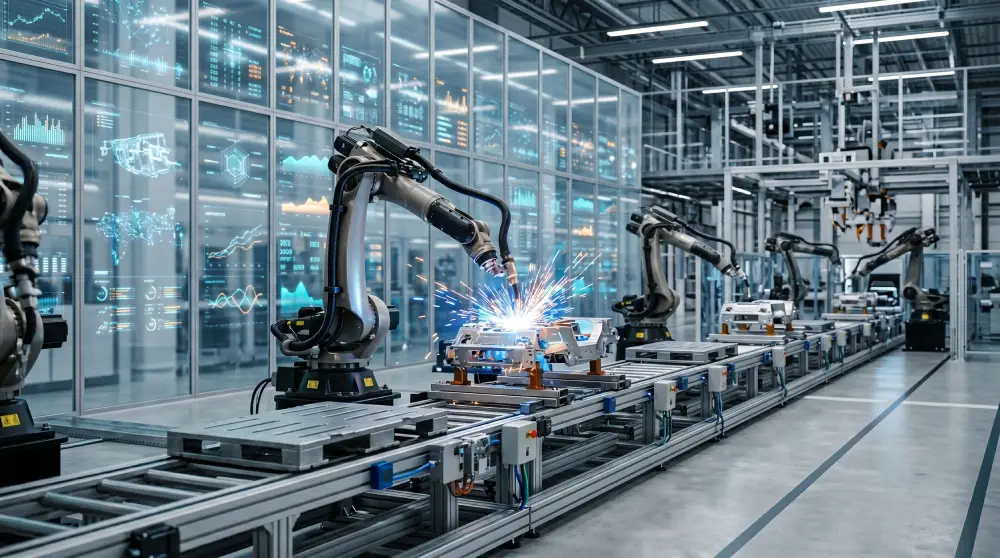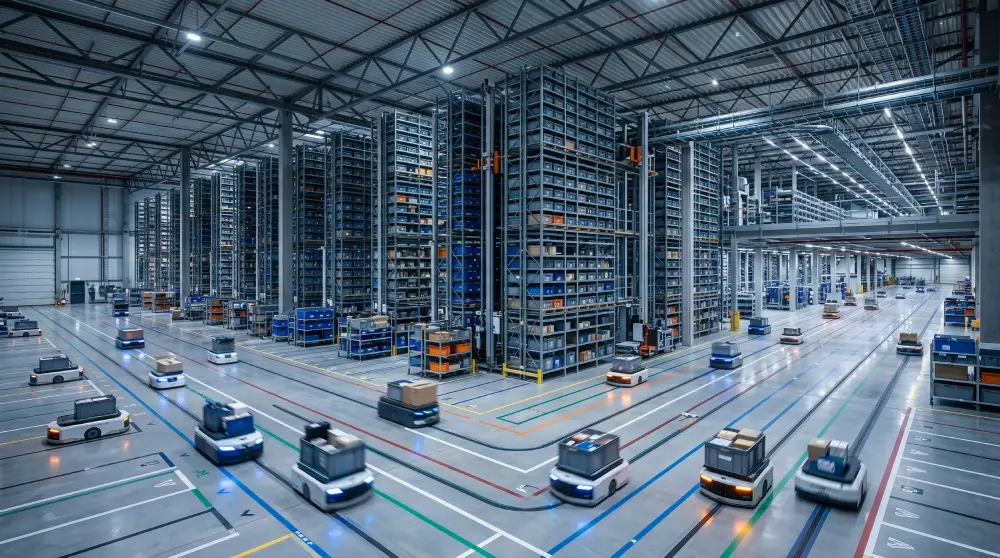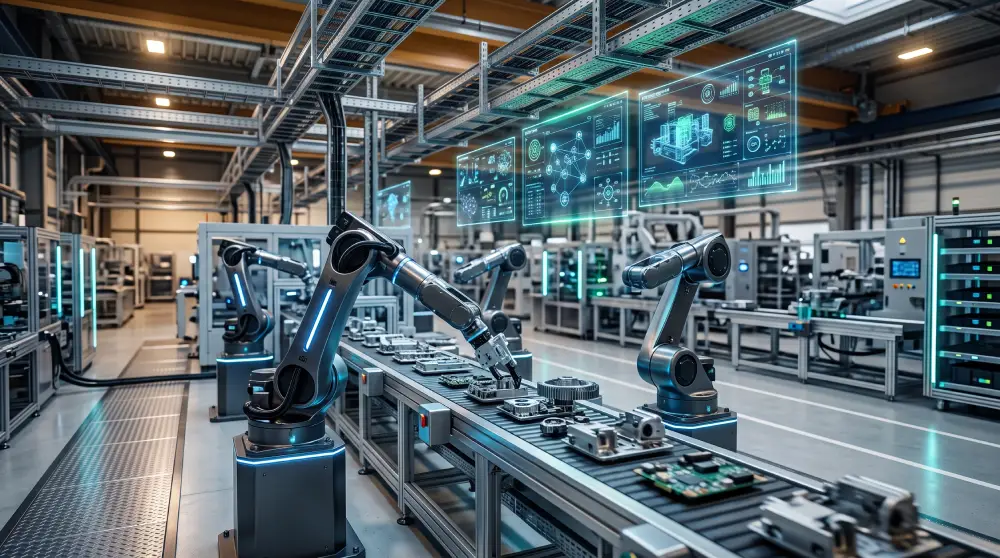
A realistic, high-tech industrial smart factory interior during production. Sleek automated robotic arms assemble precision components on a clean conveyor line. Giant holographic digital twin interfaces float above the machinery, displaying glowing blue and green data visualizations, network nodes, and predictive maintenance charts. Warm ambient lighting interacts with the cool neon blue accents of the cyber-physical systems. The atmosphere is highly professional, modern, and clean, perfectly capturing the essence of advanced industrial automation. No text, no words, no letters, no human faces.
- Introduction to the Industry 4.0 Implementation Guide
- Understanding the Core Pillars of a Modern Manufacturing Framework
- Step by Step Industry 4.0 Implementation Guide for Operational Success
- Overcoming Key Challenges Stated in this Industry 4.0 Implementation Guide
- Long Term Benefits of Executing an Industry 4.0 Implementation Guide
- FAQs
Introduction to the Industry 4.0 Implementation Guide
The manufacturing sector is undergoing a profound digital transformation. Legacy production environments are rapidly evolving into highly interconnected, smart ecosystems. At the heart of this revolution is the convergence of operational technology and information technology. Business leaders must navigate this shifting landscape to maintain a strong competitive edge, minimize waste, and improve resource efficiency.
This comprehensive Industry 4.0 implementation guide provides a structured framework to help your organization adopt advanced automation, secure data architectures, and smart manufacturing workflows. systematically transitioning from reactive operations to predictive systems, your enterprise can unlock massive hidden operational capacity and build lasting supply chain resilience.
Understanding the Core Pillars of a Modern Manufacturing Framework
Before deploying new technologies on the shop floor, it is crucial to understand the structural pillars that support digital transformation. A successful strategy does not rely on a single software application. Instead, it relies on an interconnected ecosystem of advanced digital tools.
Industrial Internet of Things and High Performance Smart Sensors
The foundation of any smart factory begins with data collection. Industrial Internet of Things devices and specialized smart sensors are installed directly onto physical machinery. These sensors monitor critical metrics such as operational temperature, micro vibrations, and processing speeds in real time.
Cloud Computing and Agile Edge Architecture
Processing massive volumes of industrial data requires a balanced infrastructure strategy. While cloud computing offers centralized storage and heavy computational power for deep trend analysis, edge computing handles localized operations. Processing data at the edge minimizes network latency, allowing automated systems to make split second decisions directly on the factory floor.
Artificial Intelligence and Predictive Maintenance Models
Artificial intelligence transforms raw data streams into actionable intelligence. Machine learning algorithms analyze historical performance metrics to spot minor operational anomalies. This capability enables predictive maintenance, allowing maintenance teams to service equipment before an unexpected breakdown halts production.
Step by Step Industry 4.0 Implementation Guide for Operational Success
Transitioning to a smart factory requires a methodical approach. Moving too quickly without a clear plan often results in isolated digital pilots that fail to scale across the organization. Follow these structured steps to ensure a smooth deployment.
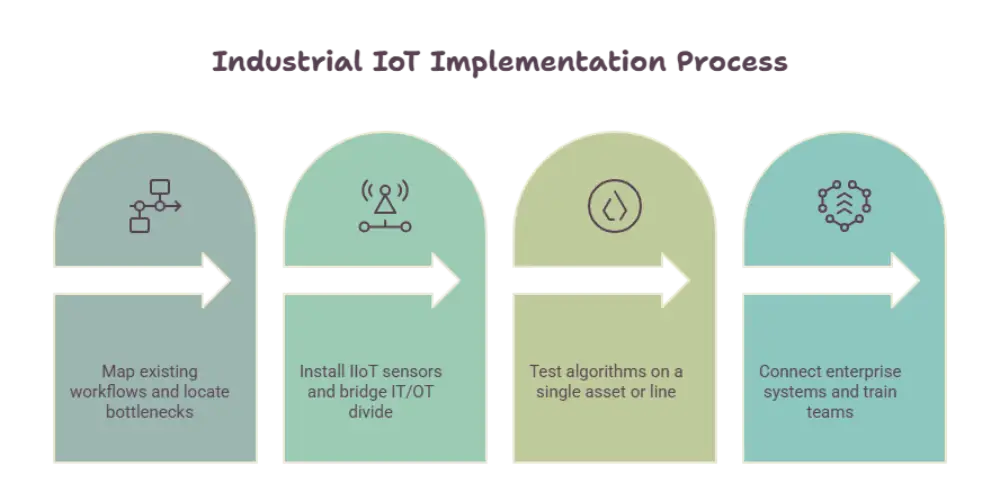
Phase 1 Audit Legacy Processes and Define Clear Business Goals
The initial phase involves a deep assessment of your current manufacturing workflows. Identify severe production bottlenecks, high energy consumption points, and frequent equipment downtime areas. Establish precise key performance indicators, such as improving Overall Equipment Effectiveness or reducing scrap rates, to measure the success of your digital investments.
Phase 2 Build the Data Infrastructure and Bridge the IT/OT Divide
A common roadblock in digital transformation is the separation between operational technology on the shop floor and information technology in the executive offices. To bridge this divide, implement standardized communication protocols like OPC Unified Architecture. This ensures that old machinery and modern enterprise planning applications can communicate seamlessly.
Phase 3 Deploy a Targeted Proof of Concept
Avoid the temptation to overhaul your entire manufacturing plant simultaneously. Select a single critical asset or one production line to serve as a testing environment. Install smart sensors, connect them to a localized data platform, and validate the predictive models. This initial proof of concept demonstrates clear business value and builds confidence among stakeholders.
Phase 4 Scale the Smart Solutions and Train the Internal Workforce
Once the proof of concept delivers measurable performance gains, begin scaling the solution across the entire enterprise. Integrate shop floor data with your centralized enterprise resource planning and computerized maintenance management systems. Simultaneously, invest in upskilling programs to help machine operators transform into confident data interpreters who can act on real time insights.
Overcoming Key Challenges Stated in this Industry 4.0 Implementation Guide
The journey toward full digital transformation comes with distinct organizational and technical challenges. Preparing for these hurdles early prevents project delays and protects your investments.
Mitigating Industrial Cybersecurity Risks
Increased digital connectivity opens new entry points for malicious cyber threats. Protecting an interconnected factory requires a strict zero trust architecture. Every connected sensor, tablet, and machine controller must be continuously authenticated. Regular network audits and robust encryption protocols must be established from day one.
Managing Culture Shifts and Workforce Adaptation
The introduction of automated systems can generate friction among workforce teams accustomed to traditional manual processes. Address this by appointing an internal digital transformation ambassador. Clear communication regarding how smart tools assist workers by reducing cognitive load and eliminating hazardous tasks helps foster a collaborative company culture.
Standardizing Data Governance and Accuracy
Artificial intelligence models are only as effective as the information they consume. If data collection is messy or unorganized, your predictive analytics will yield inaccurate results. Implement strict data quality frameworks to ensure all automated inputs are clean, properly timestamped, and consistently structured.
Long Term Benefits of Executing an Industry 4.0 Implementation Guide
Commitment to a structured digital roadmap delivers substantial operational advantages that compound over time.
- Enhanced Operational Visibility: Real time tracking dashboards display the true status of production lines, eliminating reliance on delayed manual spreadsheet reports.
- Significant Cost Reductions: Shifting from reactive maintenance to proactive planning drastically lowers emergency repair costs and extends machinery lifespans.
- Agile Production Flexibility: Interconnected modular systems allow manufacturers to adapt quickly to sudden supply chain disruptions or changing customer order specifications.
- Improved Energy Efficiency: Granular monitoring helps identify energy consumption peaks, allowing plants to optimize operations based on utility tariffs and sustainability goals.
FAQs
What is the first step in an Industry 4.0 implementation guide for small manufacturers?
The first step is always to audit existing operations and identify your largest bottleneck or source of waste. Small manufacturers should start small by adding plug and play IIoT sensors to a single critical machine rather than trying to automate the entire factory floor at once.
How long does it typically take to see results from this Industry 4.0 implementation guide?
Initial results from a targeted proof of concept can often be observed within a few months of deployment. However, a full scale enterprise transformation is a multi year journey that requires continuous optimization and cultural adaptation.
Why is bridging the IT/OT divide emphasized so heavily in this Industry 4.0 implementation guide?
Operational technology and information technology have historically run on separate networks using completely different languages. Bridging this divide is essential because smart manufacturing relies on shop floor data flowing smoothly into business management systems to enable real time decision making.
Does implementing Industry 4.0 principles mean eliminating the human workforce?
No, the goal is to augment human capabilities rather than replace them. Automated systems handle repetitive, dangerous, or highly tedious tasks, allowing human workers to focus on complex problem solving, process optimization, and strategic management.
How does predictive maintenance differ from traditional preventive maintenance?
Preventive maintenance relies on fixed schedules or time intervals, meaning parts might be replaced while still in perfectly good condition. Predictive maintenance uses real time sensor data and machine learning algorithms to determine exactly when a specific part is reaching failure, maximizing its usage and avoiding unnecessary downtime.