Key Highlights: I/DD Skill Development is crucial for enhancing the independence and quality of life for individuals with intellectual and developmental disabilities (I/DD). Foundational life skills include personal care, money management, and safe navigation. Developing strong communication skills and social abilities is key for community integration and building relationships. Effective teaching strategies involve visual supports, hands-on practice, and structured routines. Support systems, including family and Direct Support Professionals (DSPs), play a vital role in encouraging growth and independence. Physical fitness is a powerful tool for improving motor skills, confidence, and overall well-being.
Introduction
Welcome! This guide is for anyone looking to support individuals with an intellectual disability or other developmental disabilities. Our focus is on practical strategies for skill development that empower individuals, foster independence, and enhance their overall quality of life. Every person has unique strengths and goals, and with the right approach, they can build the confidence and abilities needed to lead more fulfilling and self-directed lives. Let’s explore how to make that happen.
Understanding Intellectual and Developmental Disabilities (I/DD)
Intellectual and developmental disabilities (I/DD) encompass a range of conditions that can affect an individual’s cognitive functioning and adaptive behavior. Individuals with I/DD often face unique challenges in acquiring daily living skills and building essential life skills. Understanding these disabilities is crucial for tailoring support services to meet personal goals. Positive reinforcement plays a vital role in fostering new skills and enhancing quality of life. Engaging in community activities and fostering social interaction can significantly help individuals with I/DD navigate their daily tasks and encourage independent living.
What Are Intellectual and Developmental Disabilities?
Intellectual and developmental disabilities (I/DD) refer to a broad range of conditions that originate in the developmental period. An intellectual disability specifically involves limitations in both intellectual functioning—like reasoning and learning—and adaptive behavior, which covers practical, everyday life skills.
These conditions can vary widely in severity and cause. Some common examples of I/DD include Autism Spectrum Disorder, Down Syndrome, and Cerebral Palsy, a disorder affecting movement and muscle tone. According to the Centers for Disease Control and Prevention, these conditions can be caused by genetic factors, environmental influences, or unknown reasons.
It is also important to recognize that individuals with I/DD may experience co-occurring mental health conditions. Addressing both the developmental disability and any mental health needs is crucial for creating a comprehensive support plan that promotes overall well-being and a better quality of life.
How I/DD Impacts Skill Acquisition and Daily Living
Skill acquisition in individuals with intellectual and developmental disabilities (I/DD) can vary greatly, influencing daily living and essential life skills. Many individuals may face unique challenges, requiring tailored support plans that emphasize building both independent living skills and social interaction. A comprehensive approach is crucial, integrating emotional development and practical skills. Positive reinforcement plays a significant role in motivating progress while ensuring personal goals align with their desires. Community engagement and consistent support from family and direct support professionals enhance quality of life, enabling meaningful participation in the lives of others.
The Importance of Skill Development for People with I/DD
Skill development is the cornerstone of a fulfilling life for individuals with I/DD. Learning new abilities directly translates to a higher quality of life, greater independence, and the confidence to participate more fully in the community. It empowers people to take control of their lives and make their own choices.
focusing on building practical competencies, you help individuals move closer to achieving their personal goals, whether that involves living more independently, finding meaningful employment, or engaging in social activities. The next sections will explore how skill development boosts independence and builds self-confidence.
Enhancing Independence and Quality of Life
Achieving independent living is a primary goal for many individuals with I/DD, and skill development is the path to get there. When a person learns how to manage personal care, prepare meals, or navigate their community, their quality of life improves dramatically. These abilities reduce reliance on others and foster a sense of autonomy.
Effective support plans are person-centered, focusing on the specific skills an individual needs to thrive. Essential skills often include personal hygiene, safety awareness, problem-solving, and money management. Mastering these areas allows individuals to handle daily challenges with greater confidence.
Ultimately, the goal is to empower people to make their own choices and lead self-directed lives. As they build competence in everyday tasks, they gain the freedom to pursue their interests, engage with their community, and live with dignity and self-sufficiency.
Building Self-Confidence and Social Inclusion
Mastering new skills has a powerful effect on self-confidence. When an individual successfully learns a new task or reaches a physical fitness goal, it provides a tangible sense of accomplishment. This boost in self-esteem can change how they see themselves and motivate them to tackle new challenges.
This newfound confidence often extends into social settings. A person who feels capable is more likely to initiate social interaction and participate in community engagement activities. Developing social skills—like teamwork in a group fitness class or communication during a shared activity—is essential for building relationships.
Stronger interpersonal skills and higher self-confidence create a positive cycle. They enable individuals to form friendships, join community groups, and feel a true sense of belonging. This social inclusion is a critical component of long-term independence and overall well-being.
Foundational Life Skills for Individuals with I/DD
Before tackling more complex tasks, it is essential to build a strong base of foundational skills. These core life skills are the building blocks for independent living and include everything from communication to personal care. Without them, navigating the world becomes much more challenging.
Mastering these fundamentals gives individuals the confidence and ability to take on more advanced skills later. In the sections below, we will look at two of the most critical areas: communication and self-care.
Communication and Social Interaction Skills
Strong communication skills are vital for nearly every aspect of life, from expressing needs to building relationships. For individuals with I/DD, developing these skills is key to self-advocacy and successful social interaction. It empowers them to connect with others and participate in their communities.
Improving interpersonal skills helps individuals navigate social situations with more confidence. This can be practiced in structured settings, like group activities, or in everyday encounters. The American Speech-Language-Hearing Association (ASHA) emphasizes that these skills are crucial for forming meaningful connections. Key skills to focus on include:
- Assertiveness to express thoughts and feelings.
- Active listening to understand and respond to others.
- Interpreting nonverbal cues like body language.

Ultimately, better communication facilitates community integration. When a person can clearly ask for help, share their interests, or work with a team, they are better equipped to lead an independent and socially rich life.
Self-Care and Personal Hygiene Essentials
Personal care and hygiene are among the most fundamental daily living skills. Mastering these daily tasks is a major step toward independent living, as it directly impacts health, well-being, and social acceptance.
Good hygiene routines contribute to physical health and boost self-esteem. Breaking down these tasks into simple, manageable steps can make them easier to learn. Visual aids, like a chart in the bathroom, can provide helpful reminders and create a structured routine.
Key self-care skills include:
- Daily grooming, such as brushing teeth and hair.
- Bathing or showering regularly.
- Dressing appropriately for the weather or occasion.
gaining proficiency in these areas, individuals can take charge of their own well-being, which is a cornerstone of living a self-sufficient and dignified life.
Practical Daily Living Skills
Beyond foundational skills, mastering practical skills for daily living is what truly unlocks greater autonomy. These independent living skills cover a wide range of activities that many people take for granted, from managing money to getting around town safely.
Are there specific training programs designed to help people with I/DD develop these skills? Yes, many organizations offer specialized programs. Let’s explore some of the most important practical skills and how they can be taught.
Money Management and Financial Literacy
Money management is a critical skill for independent daily living. Developing financial literacy helps individuals understand the value of money, make responsible purchases, and work toward financial goals. This skill empowers them to participate more fully in the community, whether it’s shopping for groceries or paying for an activity.
Support services can play a key role in teaching these concepts. Instruction often starts with the basics, such as identifying coins and bills, and progresses to more complex tasks like creating a budget or using a debit card.
Breaking down budgeting into simple categories can make it more understandable.
| Budgeting Skill | Description |
|---|---|
| Identifying Money | Learning to recognize different coins and bills. |
| Making a Purchase | Practicing how to pay for an item and receive change. |
| Simple Budgeting | Allocating money for different needs, like food and fun. |
| Saving | Setting aside money for a future goal or purchase. |
Safe Navigation and Transportation Skills
Having reliable transportation skills is essential for independence and community integration. The ability to travel safely opens up opportunities for employment, socializing, and accessing essential services. Safe navigation, whether walking or using public transit, is one of the most empowering practical skills a person can learn.
Instruction should begin with basic safety rules and gradually move to more complex scenarios. For example, start by practicing walking routes in the neighborhood before introducing the bus system. Repetition and real-world practice are key to building confidence.
Essential transportation skills to develop include:
- Understanding traffic signals and crossing streets safely.
- Learning how to read a bus or train schedule.
- Knowing how to use ride-sharing apps or other transportation services.
Mastering these skills allows individuals to expand their world and participate more freely in daily living.
Social and Emotional Skills for Success
Success in life isn’t just about practical abilities; it’s also about managing emotions and connecting with others. Developing social skills and fostering healthy emotional development are crucial for building relationships, navigating social situations, and achieving personal well-being.
Strong interpersonal skills allow individuals to participate in community engagement with confidence. The following sections will cover strategies for developing emotional regulation and fostering healthy relationships, two key components for social success.
Developing Emotional Regulation and Coping Strategies
Emotional regulation is the ability to manage and respond to emotional experiences in a healthy way. This is a crucial area of skill development for everyone, especially for individuals with I/DD who may find it harder to process and express their feelings. Teaching effective coping strategies is essential for their mental health and overall well-being.
One way to approach this is by helping individuals identify their emotions and what triggers them. Simple tools like a feelings chart or social stories can be very effective. Once an emotion is identified, you can practice coping mechanisms like taking deep breaths, listening to music, or taking a short walk.
Healthy emotional development is closely linked to success in other areas. When a person feels emotionally stable, they are better equipped to focus on learning new skills and facing daily challenges. Co-occurring mental health conditions can complicate skill development, making emotional support an even higher priority.
Fostering Healthy Relationships and Boundaries
Building healthy relationships is a cornerstone of a happy and fulfilling life. This involves teaching essential interpersonal skills, such as how to communicate respectfully, show empathy, and cooperate with others. Just as important is teaching the concept of personal boundaries—both in setting them and respecting those of others.
Guidance on appropriate social interaction can help individuals understand the unwritten rules of friendship and community life. This includes topics like personal space, sharing, and how to start and end conversations. This knowledge builds confidence and reduces social anxiety.
A strong support network of friends and family provides a safe space to practice these skills. Fostering these connections contributes directly to long-term independence by creating a community of people who can offer help, companionship, and a sense of belonging.
Strategies for Effective Skill Instruction
How you teach a skill is just as important as what you teach. Effective skill instruction for individuals with I/DD often looks different from traditional methods. Many skill development programs rely on structured, supportive, and motivational techniques to help learners succeed.
Strategies like using positive reinforcement to celebrate progress and setting clear, specific goals can make a huge difference. The following sections will explore two highly effective approaches: using visual supports and leveraging hands-on practice.
Using Visual Supports and Structured Teaching Methods
Structured teaching is a method that uses organization and visual supports to make tasks and expectations clear. This approach is highly effective for skill instruction because it reduces anxiety and confusion by creating a predictable environment. It helps individuals know what is happening, when it is happening, and what they need to do.
Visual supports can take many forms, from picture schedules to step-by-step instruction cards. These tools translate abstract verbal instructions into concrete, easy-to-follow guides. They are especially helpful for teaching multi-step routines and promoting positive adaptive behavior.
Examples of effective visual supports include:
- Picture schedules for daily routines (e.g., morning, bedtime).
- Checklists for completing chores or assignments.
- Social stories that visually explain social situations and expected behaviors.
Using these tools makes learning less stressful and more accessible, empowering individuals to complete tasks with greater independence.
Leveraging Hands-On, Real-Life Practice
For many practical skills, the best way to learn is by doing. Hands-on learning allows individuals to connect concepts to actions, which is often more effective than just talking about a task. This approach is all about real-life practice in the environments where the skill will actually be used.
For example, learning to cook is best done in a kitchen, and learning to shop is best done in a store. This contextual learning helps solidify skills and build confidence in handling everyday tasks. It transforms theoretical knowledge into practical ability.
You can create opportunities for hands-on learning by:
- Working together in a partner exercise to practice teamwork.
- Role-playing a conversation before going to the store.
- Practicing a bus route together during a low-stress time of day.
This approach makes skill development relevant and engaging, increasing the likelihood that the new skills will be remembered and used.
Role of Fitness and Physical Activity in Skill Development
Did you know that fitness can be a powerful tool for skill development? Regular physical activity does more than just improve physical well-being; it also helps enhance motor skills, focus, and even social abilities. It’s a fun and engaging way to work on essential life skills.
Physical activity provides a hands-on way to learn patience, follow instructions, and work with others. The following sections will explain how fitness promotes motor skills and how movement can be integrated into other learning activities to support holistic development.
Promoting Motor Skills and Physical Well-Being
Regular fitness activities are excellent for improving both fine and gross motor skills. Activities that require balance, coordination, and strength help individuals gain better control over their bodies. This improved physical capability is a key component of overall skill development.
Enhanced physical well-being has a direct impact on daily life. For instance, a stronger core and better balance can make tasks like getting dressed or carrying groceries much easier. When you understand your own body parts and how they move, you build a foundation for physical independence. A 2024 review in Healthcare found that physical activity positively impacts multiple domains of quality of life for people with I/DD [Source: https://www.frontiersin.org/journals/sports-and-active-living/articles/10.3389/fspor.2023.1184946/full].
Some exercises that promote motor skills include:
- Squats and lunges to build leg strength and balance.
- Stretching to improve flexibility and body awareness.
- Team sports like basketball or soccer to enhance coordination.
Integrating Movement into Learning Activities
Movement can make learning activities more dynamic and effective. Combining physical tasks with cognitive ones helps reinforce concepts and keeps learners engaged. This approach taps into the connection between the mind and body to support holistic development.
For example, instead of just counting on paper, you can count while doing jumping jacks. This integration of fitness makes learning less passive and more memorable. It’s a great way to practice motor skills while working on other educational goals.
Here are a few ideas for integrating movement:
- Tossing a ball back and forth while practicing vocabulary words.
- Acting out a story to improve comprehension and expression.
- Using dance to learn about rhythm and patterns.
This method makes learning fun and helps individuals with I/DD process information in a multi-sensory way, leading to better retention and engagement.
Support Systems for Ongoing Skill Growth
No one achieves their goals alone. Meaningful and lasting skill growth requires strong support systems. These systems include family, friends, and professionals who create tailored support plans and provide encouragement along the way. A reliable support network is essential for navigating challenges and celebrating successes.
A key part of this network is often direct support professionals (DSPs), who provide specialized assistance. Let’s look at the crucial roles that families and DSPs play in fostering independence.
Family Involvement in Encouraging Independence
Family members are often the most important part of an individual’s support network. Your encouragement and involvement can make a huge difference in building skills for independence. Creating a supportive home environment where it is safe to practice and make mistakes is crucial.
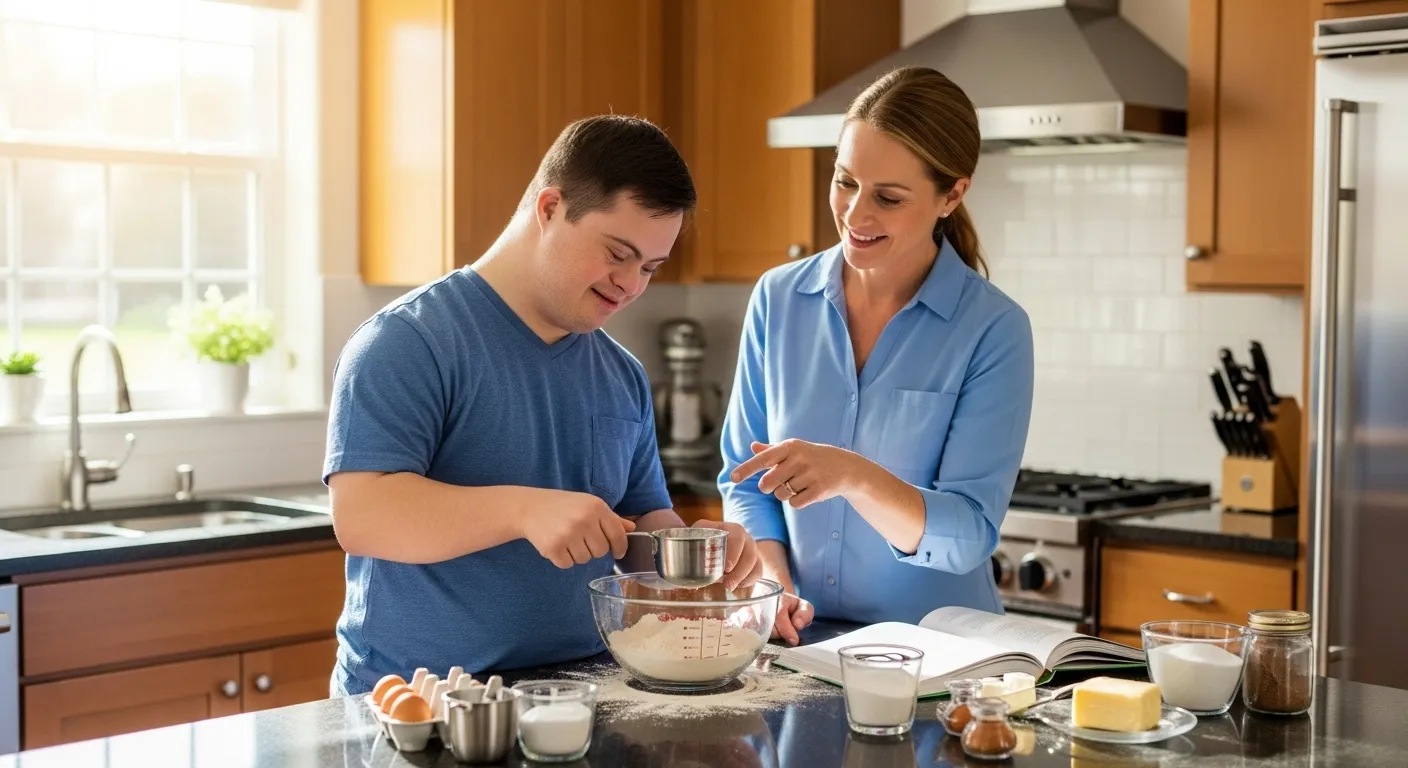
One of the best ways to help is by integrating skill practice into everyday life. Spending time together on tasks like cooking, cleaning, or going for walks provides natural learning opportunities. This consistent, real-world practice helps solidify skills and shows your loved one that you believe in their ability to achieve their personal goals.
Families can support skill development by:
- Creating simple, consistent routines for daily tasks.
- Celebrating small achievements to build confidence.
- Collaborating with support professionals to align on goals and strategies.
The Impact of Direct Support Professionals and Staff
Direct support professionals (DSPs) and other staff from support services play a crucial role in skill development. These trained professionals are experts at implementing person-centered plans and using effective teaching strategies to help individuals reach their goals.
The work of a DSP goes far beyond basic care; they are teachers, coaches, and advocates. They play an immense part in the lives of individuals with I/DD by empowering them to become more independent and integrated into their communities. The Trudeau Center emphasizes this collaborative approach to help individuals achieve their aspirations [Source: https://www.trudeaucenter.org/].
DSPs support skill development by:
- Adapting activities and exercises to fit individual abilities.
- Providing positive reinforcement and constructive feedback.
- Connecting individuals with community resources and activities.
Overcoming Challenges in Skill Development
The path to skill development is not always smooth. Individuals with I/DD may face various challenges and barriers that can make learning more difficult. These can range from cognitive limitations to co-occurring mental health issues.
Acknowledging these obstacles is the first step to overcoming them. understanding the unique needs of each person and adjusting specific goals and strategies accordingly, we can create a supportive environment where progress is possible. The following sections will discuss how to address these barriers and balance skill-building with mental well-being.
Addressing Common Barriers and Individual Needs
One of the most common barriers to skill development is a one-size-fits-all approach. Every person has individual needs, and effective support must be tailored to their specific strengths and challenges. This is where person-centered support services are invaluable.
Difficulties with adaptive behavior or co-occurring mental health conditions can also present significant hurdles. For example, anxiety may make it hard for someone to try a new task, or a physical limitation may require adaptations to an activity. Recognizing and addressing these underlying issues is critical for success.
Strategies for overcoming barriers include:
- Breaking down skills into very small, manageable steps.
- Modifying the environment to make it more supportive.
- Providing consistent routines to reduce anxiety and build predictability.
being flexible and responsive, you can help individuals navigate these challenges and continue to make progress.
Balancing Mental Health and Skill-Building Efforts
Mental health and skill-building are deeply intertwined. Pushing too hard can lead to frustration and burnout, while ignoring skill development can impact self-esteem and independence. Finding the right balance is key. A strong support network can provide the emotional safety net needed to take on new challenges.
Setting realistic and specific goals helps manage expectations and prevent individuals from feeling overwhelmed. It’s important to focus on progress, not perfection. Using positive reinforcement to celebrate effort and small victories can keep motivation high and reinforce a positive mindset.
When mental health challenges are present, it’s important to:
- Prioritize emotional well-being over rapid skill acquisition.
- Incorporate calming activities and coping strategies into daily routines.
- Work closely with mental health professionals to ensure a coordinated approach.
This balanced approach ensures that skill development is a positive and empowering experience.
Conclusion
In conclusion, developing essential skills for individuals with intellectual and developmental disabilities (I/DD) is crucial for enhancing their quality of life and fostering independence. focusing on foundational life skills, practical daily living skills, and social-emotional competencies, we can empower those with I/DD to navigate their world more effectively. Implementing structured teaching methods, promoting physical activity, and engaging family support systems can further facilitate skill acquisition. Remember, every small step counts towards building confidence and creating a supportive environment. If you’re looking for tailored strategies or need assistance in skill development, don’t hesitate to reach out for a free consultation with our experts!
Frequently Asked Questions
Are there specialized programs for teaching life skills to people with I/DD?
Yes, many organizations offer skill development programs designed for people with developmental disabilities. These programs teach essential life skills and practical skills through structured activities and person-centered approaches. They help individuals work toward specific goals in areas like daily living, communication, and vocational training, promoting greater independence.
How can families best support skill development at home?
Family members can be powerful allies in supporting skill development. You can help by creating consistent routines, practicing skills during everyday activities, and celebrating progress toward personal goals. Working together on support plans helps ensure that efforts at home align with professional services, greatly improving the lives of people striving for independent living.
What resources help with skill-building for adults with I/DD?
Many resources are available, including state and local support services, community-based day programs, and vocational training centers. These programs focus on daily living skills, employment, and social integration. Advocacy groups and a strong support network also play a crucial role by connecting adults with the right opportunities.