Machine learning explained in simple terms is the process of teaching computers to learn from data and improve their performance over time without being explicitly programmed for every task. Instead of following fixed rules, machine learning systems identify patterns in data and use those patterns to make predictions or decisions. This technology now powers everything from voice assistants to fraud detection systems, making it one of the most important innovations of our time.
What Is Machine Learning
Machine learning is a branch of artificial intelligence that focuses on building systems capable of learning from experience. Rather than programmers writing detailed instructions for every possible scenario, they feed the system large amounts of data and let algorithms discover relationships within that data.
Over time, the system refines its understanding and becomes better at completing tasks such as recognizing images, translating languages, or predicting customer behavior.
Why Machine Learning Matters Today
Businesses and researchers rely on machine learning because it allows them to process massive amounts of information quickly and accurately. This capability helps industries like healthcare, finance, retail, and transportation make smarter decisions, automate repetitive tasks, and uncover insights that would be impossible to find manually.
How Machine Learning Works
At its core, machine learning follows a simple cycle. The system receives data, learns patterns from that data, makes predictions, and then adjusts itself based on how accurate those predictions were.
Step One: Data Collection
Every machine learning model needs data to learn from. This data can include text, images, numbers, or any other measurable information. The quality and quantity of data directly affect how well the model performs.
Step Two: Training the Model
During training, the algorithm analyzes the data and identifies patterns or relationships. It adjusts its internal parameters repeatedly to minimize errors and improve accuracy.
Step Three: Testing and Evaluation
Once trained, the model is tested on new data it has not seen before. This helps determine whether it can generalize its learning to real world situations rather than simply memorizing the training data.
Step Four: Continuous Improvement
Machine learning models often continue to learn and adapt as new data becomes available, allowing them to stay relevant and accurate over time.
Types of Machine Learning
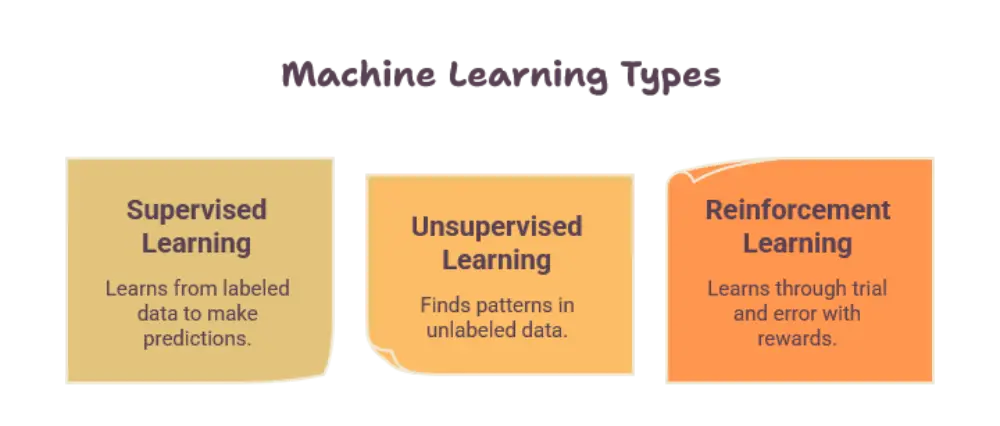
Understanding the different types of machine learning helps clarify how various applications function.
Supervised Learning
Supervised learning uses labeled data, meaning the correct answer is already known. The algorithm learns by comparing its predictions to the actual results and adjusting accordingly. Common examples include spam email detection and predicting house prices.
Unsupervised Learning
Unsupervised learning works with unlabeled data. The system tries to find hidden patterns or groupings on its own. This approach is often used for customer segmentation and anomaly detection.
Reinforcement Learning
Reinforcement learning involves an agent that learns by interacting with an environment and receiving rewards or penalties based on its actions. This method is commonly used in robotics, gaming, and self driving vehicles.
Real World Applications of Machine Learning
Machine learning has become deeply integrated into everyday life, often without people realizing it.
Healthcare
Machine learning helps doctors detect diseases earlier by analyzing medical images and patient data, improving diagnostic accuracy and treatment planning.
Finance
Financial institutions use machine learning to detect fraudulent transactions, assess credit risk, and automate trading strategies.
Retail and E Commerce
Online stores use machine learning to recommend products, personalize shopping experiences, and forecast demand.
Transportation
Self driving cars and traffic prediction systems rely heavily on machine learning to interpret sensor data and make real time decisions.
Common Machine Learning Algorithms
Several algorithms form the foundation of most machine learning applications.
Linear Regression
Used for predicting numerical values based on relationships between variables.
Decision Trees
A visual and logical way of making decisions based on a series of conditions.
Neural Networks
Inspired by the human brain, neural networks are especially powerful for complex tasks like image and speech recognition.
Clustering Algorithms
These group similar data points together, often used in market segmentation.
Challenges in Machine Learning
Despite its benefits, machine learning comes with challenges that researchers continue to address.
Data Quality Issues
Poor quality or biased data can lead to inaccurate or unfair predictions.
Model Interpretability
Some machine learning models, especially deep learning systems, function like black boxes, making it difficult to understand how they reach conclusions.
Overfitting
This occurs when a model performs well on training data but struggles with new, unseen data.
The Future of Machine Learning
Machine learning continues to evolve rapidly, with advancements in natural language processing, computer vision, and automation. As algorithms become more efficient and data availability increases, machine learning will likely become even more embedded in daily life, transforming industries and creating new opportunities for innovation.
Conclusion
Machine learning explained simply is the science of enabling computers to learn from data and improve without explicit programming. From healthcare to finance to everyday consumer technology, its impact is already widespread and growing. Understanding the basics of how machine learning works, its types, and its applications provides a strong foundation for anyone curious about this transformative technology. As data continues to grow and algorithms become smarter, machine learning will remain at the center of technological progress for years to come.
FAQs
What is machine learning in simple words?
Machine learning is a type of artificial intelligence where computers learn patterns from data to make predictions or decisions without being directly programmed for each task.
What are the main types of machine learning?
The main types are supervised learning, unsupervised learning, and reinforcement learning, each differing in how the system learns from data.
How is machine learning used in daily life?
It powers voice assistants, product recommendations, fraud detection, navigation apps, and personalized content on social media platforms.
Is machine learning the same as artificial intelligence?
No. Machine learning is a subset of artificial intelligence that focuses specifically on learning from data, while AI covers a broader range of intelligent systems.
What skills are needed to learn machine learning?
A good foundation in mathematics, statistics, and programming, especially Python, along with an understanding of data analysis, helps beginners get started with machine learning.