Do you ever wonder if you have the right amount of car insurance coverage? It’s a common question, and the answer is critical for your financial stability. Choosing an insurance policy can feel complicated, but it doesn’t have to be. This guide will give you straight answers about what coverage you really need, how much it costs, and how to make sure your policy truly protects you. the end, you’ll be able to confidently determine if your current car insurance is enough for your needs. Working with a local auto insurance agency can benefit you by providing personalized service and expert advice tailored to your unique situation. Local agents understand the specific requirements and risks in your area, which means they can recommend coverage options that truly fit your needs.
Understanding Oregon’s Car Insurance Requirements
Every state sets its own rules for the minimum auto insurance drivers must carry, and Oregon is no exception. These laws are designed to ensure that if you cause an accident, you have some level of financial backing to cover the damages you cause to others. This required insurance is known as liability coverage.
In addition to meeting Oregon’s car insurance requirements, drivers may be interested to know that many auto insurance agencies commonly offer various discounts. These discounts can include safe driver rewards, bundling multiple policies, or incentives for students with good grades, all of which can help make coverage more affordable.
However, just meeting the state’s minimum coverage doesn’t mean you are fully protected. An insurance company will offer many types of coverage, and understanding the basics is the first step toward making an informed choice for your car insurance policy. When requesting a car insurance quote from an agency, you will typically need to provide information such as your driver’s license number, details about your vehicle (make, model, year, and VIN), your driving history, and the coverage options you are considering. Let’s look at what the minimum requirements include and, more importantly, what they leave out.
What State Minimum Coverage Includes (and Leaves Out)
Oregon law requires all drivers to carry a specific amount of liability insurance. This includes bodily injury liability for one person, bodily injury liability for all people in an accident, and property damage liability. These coverage limits are designed to pay for the other person’s medical bills and property damage when you are at fault.
If you have an accident and need to file a claim through your auto insurance agency, you should contact your insurer as soon as possible, provide detailed information about the accident, and submit any supporting documents such as police reports and photos. Your insurance agency will guide you through the claims process and explain how your liability coverage applies based on Oregon law.
The problem is that these minimums are quite low. A serious accident can easily result in costs that far exceed these limits. For example, if you cause an accident that injures multiple people or damages a new, expensive vehicle, you could be personally responsible for paying any costs that go beyond your policy’s coverage limits. When auto insurance agencies determine your car insurance rates, they consider several factors such as your driving history, the type of car you drive, your location, your age, and even your credit score in some states. They also assess your chosen coverage limits and deductible amounts. All of these elements help the agency calculate the level of risk you present, which in turn influences the rate you pay for your policy.
This is the biggest gap in state minimum coverage: it does nothing to pay for your own car’s repairs or your own medical bills if you are at fault. To get that kind of protection, you need to look beyond the basic liability insurance and consider additional coverage based on your insurance needs. Getting car insurance quotes for different levels can show you the cost-benefit of more protection.
Common Gaps in Basic Coverage Every Driver Should Know
Relying solely on minimum coverage can lead to significant financial trouble after a car accident. These policies are designed to be a starting point, but they leave major gaps that can affect your financial stability. It’s important to be aware of what your basic policy won’t cover so you can make choices that fit your unique needs. Auto insurance agencies determine your car insurance rates by evaluating several factors, including your driving history, age, vehicle type, location, and the coverage options you select. These variables help agencies assess risk and set premiums accordingly, so it’s beneficial to understand how each factor influences your final rate when choosing the right policy.
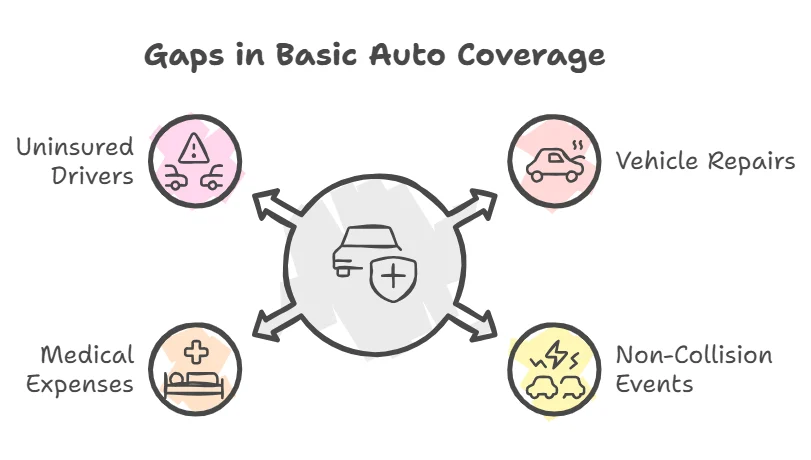
Many drivers are surprised to learn what isn’t included. For instance, if your car is damaged in a hailstorm or stolen, a minimum policy won’t help you. If you get into an accident with a driver who has no insurance, you could be left with your own bills unless you have the right coverage options.
Here are some of the most common gaps in basic coverage:
- Your own vehicle’s repairs: If you cause an accident, liability only pays for the other party’s damages.
- Non-collision events: Damage from theft, fire, vandalism, or weather is not covered.
- Your own medical expenses: Personal Injury Protection (PIP) is required, but its limits might not cover all your medical bills in a serious crash.
- Accidents with uninsured drivers: Without specific coverage, you’ll be paying out-of-pocket if an uninsured driver hits you.
Comparing Minimum Coverage to Full Coverage
When you shop for car insurance, you’ll often hear the terms “minimum coverage” and “full coverage.” The difference is substantial. Minimum coverage is just what the state requires you to legally drive, which is basic liability protection. It’s the cheapest option, but it offers the least amount of protection.
Full coverage, on the other hand, is a combination of policies that includes liability plus collision and comprehensive coverage. This package protects your own vehicle from damage, not just the other driver’s. While insurance costs are higher for full coverage, the protection it offers can save you thousands of dollars. We’ll explore the cost differences and when it makes sense to invest in more car insurance coverage.
Cost Differences: Real-World Premiums and What You Get
The price difference between minimum and full coverage can be significant, but so is the level of protection. The premium rates you pay are influenced by many factors, including your driving record, vehicle, and location. However, on average, you can expect your monthly costs to be much lower for a policy that only meets state requirements.
A car insurance company calculates your insurance premiums based on risk. A minimum policy is cheaper because the insurer’s potential payout is capped at lower coverage limits. Full coverage costs more because the company agrees to cover a wider range of incidents, including damage to your own expensive vehicle.
Here’s a general idea of how average monthly rates might compare. Keep in mind these are just estimates; your actual rates will vary.
| Coverage Type | Average Monthly Cost | What It Generally Covers |
|---|---|---|
| Minimum Coverage | $50 – $70 | Bodily injury and property damage to others. |
| Full Coverage | $120 – $150 | Liability, plus collision and comprehensive for your car. |
When Full Coverage Is Worth the Extra Money
Is upgrading to full coverage a smart financial move for you? For many drivers, the answer is a clear yes. The decision often comes down to the value of your car and your ability to handle a major, unexpected expense. If you can’t afford to replace your car out-of-pocket tomorrow, full coverage is likely a wise investment.
An insurance policy with collision coverage and comprehensive coverage provides a safety net. Its financial strength lies in its ability to protect your primary asset—your vehicle. If you have a loan or lease on your car, your lender will almost certainly require you to carry full coverage to protect their investment.
Consider opting for full coverage if:
- Your car is less than 10 years old or worth more than a few thousand dollars.
- You have a car loan or are leasing your vehicle.
- You couldn’t easily afford to repair or replace your car if it were totaled in an accident.
Breaking Down Your Policy: Collision, Comprehensive, and More
Beyond basic liability, your auto policy can include several other types of coverage. The two most common additions are collision and comprehensive coverage. Together, these are what people usually refer to when they say “full coverage.” They are designed to pay for damage to your own vehicle.
Understanding what each one does is key to building a policy that truly protects you. An insurance agent can walk you through the specifics, but it’s helpful to know the basics. These coverages handle different scenarios, from accidents you cause to events completely out of your control. Let’s examine what collision and comprehensive insurance do and what they don’t.
What Collision and Comprehensive Insurance Cover (and Don’t)
Collision and comprehensive coverage are often sold together, but they protect your vehicle from different types of harm. It’s crucial to understand the distinction when evaluating your car insurance coverage options.
Collision coverage specifically pays to repair or replace your car if it’s damaged in a collision with another object. This could be another vehicle, a telephone pole, a fence, or even a pothole. It applies regardless of who is at fault. Comprehensive coverage, on the other hand, handles almost everything else. It covers damage from non-collision events.
Here’s a quick breakdown:
- Collision covers: Damage from hitting another car or object, and rollovers.
- Comprehensive covers: Theft, vandalism, fire, hail, flooding, and hitting an animal.
- Neither covers: Normal wear and tear, mechanical failures, or personal belongings stolen from your car (which may be covered by homeowners or renters insurance).
Choosing the Right Types and Amounts of Coverage for Your Vehicle
Selecting the right insurance products involves more than just picking a company. You need to tailor your coverage limits and types of coverage to your specific situation. The best car insurance company for you is one that allows this customization to fit your needs and budget.
Your vehicle type is a major factor. A brand-new SUV with advanced safety features has different insurance needs than a 15-year-old sedan. Similarly, your financial situation plays a role. Higher liability limits are a good idea if you have significant assets to protect in a lawsuit.
Here are some things to consider:
- Vehicle Value: If your car is paid off and has a low resale value, you might decide to drop collision and comprehensive coverage to save money.
- Your Assets: Homeowners or individuals with substantial savings should consider higher liability limits to protect their assets from being seized in a lawsuit.
- Your Deductible: Choose a deductible you can comfortably pay out-of-pocket at a moment’s notice.
The Role of Uninsured Motorist Coverage in Oregon
In Oregon, you are required to have Uninsured Motorist (UM) coverage as part of your auto insurance policy. This is because a surprising number of drivers on the road don’t have insurance. If one of them hits you, your UM coverage steps in to pay for your injuries and related costs.
This is a critical piece of your car insurance coverage that protects you from the irresponsible actions of others. While liability coverage protects others from you, UM coverage protects you from others. Understanding your policy details in this area can prevent a major financial headache down the road.
Why It Matters and What It Protects You From
Uninsured motorist coverage is your financial shield against drivers who break the law by not carrying insurance. In a state like Oregon with a notable rate of uninsured drivers, this coverage is not just a legal requirement—it’s a necessity for your peace of mind and financial stability.
If an uninsured driver causes an accident that injures you or your passengers, this part of your policy will pay for your medical bills, lost wages, and other related damages. Without it, you would have to sue the at-fault driver directly, a process that is often lengthy and fruitless if the person has no assets to collect.
Think of it this way: you are essentially buying insurance for yourself in case the person who hits you didn’t buy it for you. There are different coverage options available, and you can choose limits that match your own liability coverage, ensuring you are well-protected no matter who is at fault.
Concrete Examples: Coverage Gaps and Dollar Stakes for Drivers
Let’s imagine a real-world scenario to see how coverage gaps can be financially devastating. Suppose you have only Oregon’s minimum liability coverage and you cause a multi-car accident on the highway. The total damage to the other vehicles is $60,000, and two people have serious injuries with medical expenses totaling $80,000.
Your minimum policy only covers up to $25,000 for one person’s injuries, $50,000 total for all injuries, and $20,000 for property damage. Your insurance company will pay out those maximums, but you are now personally on the hook for the remaining $30,000 in medical expenses and $40,000 in property damages. That’s a $70,000 bill you have to pay out of pocket.
This is how easily insurance costs can skyrocket after a car accident. Here’s a look at what could happen:
- Your assets, like your savings and home, could be at risk in a lawsuit.
- Your wages could be garnished for years to pay off the debt.
- A single mistake on the road could lead to financial ruin without adequate protection.
Conclusion
In conclusion, ensuring you have adequate car insurance coverage is essential for your peace of mind and financial security on the road. Oregon’s minimum coverage may leave you vulnerable to significant out-of-pocket expenses if an accident occurs, especially when you consider the rising costs of vehicle repairs and medical bills. understanding the distinctions between minimum and full coverage, as well as the importance of collision, comprehensive, and uninsured motorist options, you can make informed decisions tailored to your driving habits and needs. It’s crucial to reflect on your current policy and ask yourself key questions about your coverage. If you’re uncertain about your options or need professional guidance, consider reaching out to an auto insurance agency helping Oregon drivers find the right coverage. Stay protected and drive with confidence!
Frequently Asked Questions
How do I know if my deductible is too high or too low?
Your deductible is the amount you pay before your insurance kicks in. A deductible is too high if you couldn’t afford to pay it on short notice. It might be too low if your monthly premiums are straining your budget. A good insurance agent can help you find a balance that offers financial stability.
Will my insurance pay off my car loan if my car is totaled?
Not necessarily. Your car insurance coverage will pay the actual cash value of your car at the time of the car accident. If you owe more on your loan than the car is worth, you are responsible for the difference unless you have gap insurance. Review your insurance policy to see if this is included.
What questions should I ask when reviewing my current auto insurance policy?
When reviewing your auto policy, ask: Are my liability limits high enough to protect my assets? Do I have both collision and comprehensive coverage? Are my deductibles affordable? Do I have enough uninsured motorist coverage? Understanding these policy details is key to confirming you have the car insurance coverage for your needs.
How did you pick your insurance agent?
Choosing an insurance agent often involves researching their reputation, expertise, and customer service. Personal recommendations from friends or family can be invaluable. Additionally, checking online reviews and ensuring they are licensed in your state can help guarantee you select a reliable auto insurance agency for your needs.