
The manufacturing sector is undergoing its most profound transformation since the introduction of assembly lines. Industrial facilities are no longer relying on isolated machines and manual logging. Instead, they are evolving into highly interconnected networks driven by real-time data, artificial intelligence, and edge computing.
Implementing these advanced digital tools is what defines modern industrial evolution. exploring real-world smart manufacturing examples, businesses can understand how integrating artificial intelligence, the industrial internet of things, and automated robotics transforms standard factory floors into agile ecosystems capable of predicting issues before they impact production.
The shift toward industrial digitization is driven by the need for operational resilience. Modern enterprises must handle fluctuating supply chains, labor shortages, and rising operational costs. The following smart manufacturing examples demonstrate how companies utilize connected technologies to optimize workflows, safeguard profit margins, and maintain an error-free production environment.
Smart Manufacturing Examples in Action
1. Digital Twins and High-Fidelity Plant Simulation
A digital twin is a highly detailed virtual replica of a physical asset, production line, or entire manufacturing plant. Instead of testing new production layouts or equipment setups directly on the physical floor, which risks costly operational errors, engineers utilize a digital twin to run simulations.
An excellent real-world case study is found in the automotive sector. Major vehicle manufacturers use high-fidelity digital twins to map out entire production plants virtually. simulating the precise movements of human workers and automated robotic arms inside a virtual reality environment before a single piece of physical machinery is installed, engineering teams identify physical spatial conflicts and logistical bottlenecks early. This proactive digital testing reduces plant planning time by up to thirty percent, ensuring a seamless setup process when physical deployment begins.
2. Autonomous Dark Factories for Uninterrupted Production
Often referred to as lights-out manufacturing, dark factories represent an advanced level of industrial automation. These production facilities run completely autonomously without the physical requirement of human operators on the shop floor. Because the automated machinery does not need human lighting, climate control, or frequent operational breaks, these facilities run continuously.
A prominent electronic components manufacturer scaled this technology to mitigate global labor shortages and handle high-volume demands. creating fully autonomous dark production lines managed by artificial intelligence, the facility coordinates everything from printed circuit board assembly to automated structural testing. The integration of these intelligent robotic systems resulted in a ninety-two percent reduction in manual floor labor requirements and a thirty percent increase in manufacturing output per square meter.
3. Predictive Maintenance Powered by Industrial IoT Sensors
Traditional maintenance strategies rely on fixed schedules or reacting after a critical machine breaks down. Industrial internet of things sensors change this dynamic by constantly monitoring the health and operational condition of rotating machinery, motors, and conveyor belts. These sensors track subtle changes in vibration, acoustics, and core temperature.
Consider a large-scale bottling and food production facility experiencing frequent micro-stoppages on their main overhead conveyor lines. Instead of waiting for a total conveyor failure, the facility integrated vibration sensors that feed raw data directly into anomaly detection algorithms. The artificial intelligence model identifies when belt tension drifts out of target specifications forty-eight hours before a physical jam occurs. The system automatically triggers a work order in the maintenance software, reducing unplanned downtime by eighteen percent.
4. Automated Quality Inspection via Computer Vision Systems
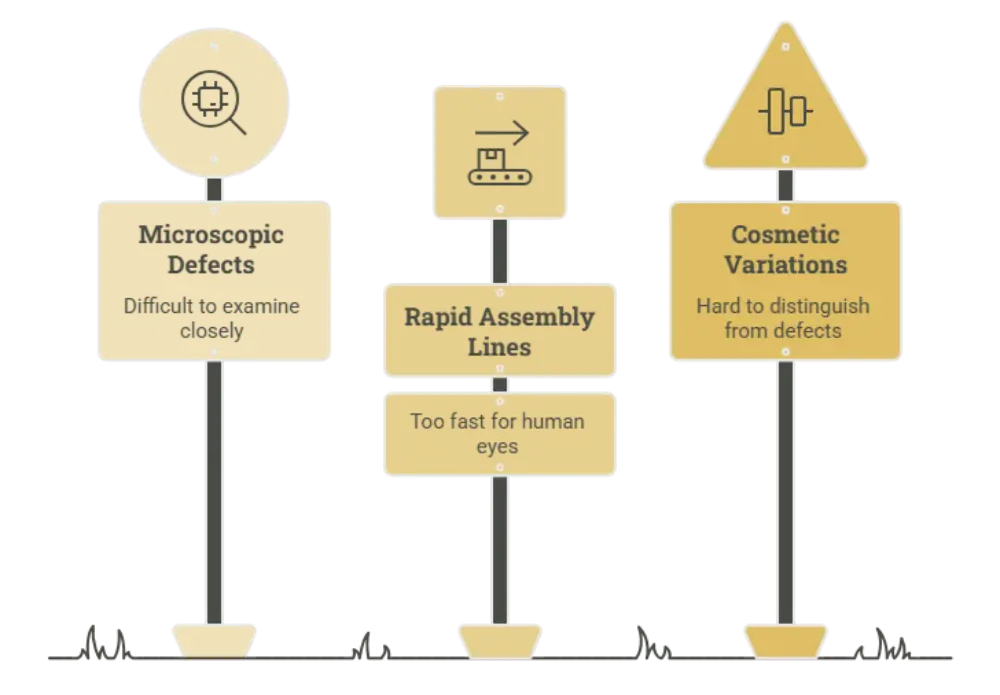
Human inspection is naturally prone to fatigue, especially when examining microscopic defects on high-density components or rapid assembly lines. Smart quality assurance solves this limitation by using high-speed cameras coupled with deep learning computer vision algorithms.
In precision electronics engineering, automated inspection systems scan thousands of solder points every single second. The system processes multiple video frames to instantly distinguish between cosmetic variations and genuine manufacturing defects. Implementing artificial intelligence vision systems allows companies to reach high levels of quality control, drastically lowering the defect rate to less than four parts per million. This level of accuracy reduces the manual review burden to just three percent of total products, freeing up human inspectors to focus on highly complex troubleshooting tasks.
5. Dynamic Living Supply Chains and Intelligent Hubs
Modern supply networks are moving away from static, linear models. Leading manufacturers now build living supply chains that actively sense, adapt, and respond to global disruptions in real time. This agility is achieved by connecting supplier logistics, commodity pricing, and regional port data into a single centralized intelligence hub.
A major global automotive manufacturer utilizes an artificial intelligence hub to continuously scan for early warning indicators, such as shipping delays in secondary ports or localized material shortages. When the model detects an upcoming disruption, it automatically resequences work orders, triggers pre-approved component substitutions, and shifts assembly schedules to keep the production flow steady. This proactive supply chain visibility eliminates sudden factory floor stoppages caused by missing components.
Key Components of a Smart Factory Infrastructure
Understanding the core technologies that support these smart manufacturing examples is essential for successful adoption. A functional smart factory relies on a unified technology stack where data flows seamlessly from the physical machine up to the enterprise software.
- Edge Intelligence: Processing industrial data close to the point of creation rather than sending everything to a distant cloud server. This reduces latency, allowing autonomous robots to make split-second operational decisions safely.
- Smart Sensors: Advanced devices that collect and filter data directly on the machine. Instead of streaming continuous, redundant information, smart sensors only alert operational teams when specific thresholds, such as maximum pressure limits, are breached.
- Connected Worker Technology: Equipping human technicians with mobile applications and augmented reality headsets. This provides real-time access to digital work instructions, allowing operators to report issues instantly and receive live process updates.
- Generative Design Platforms: Utilizing artificial intelligence to reimagine product engineering. Designers input performance requirements and material constraints, and the algorithm generates lighter, stronger structural variations that use fewer raw materials.
Strategic Roadmap for Implementing Smart Manufacturing
Transitioning to a smart factory ecosystem requires a structured approach. Manufacturers should avoid adopting new technology simply because it is trending, and instead focus on solving specific operational inefficiencies.
Identify the Core Production Bottleneck
Begin your digital transformation by analyzing where your facility experiences the most significant loss in productivity or capital. If unplanned machine downtime is draining your operational budget, focus initial investments on predictive maintenance sensors for your most critical assets.
Standardize Industrial Communication Protocols
A common challenge in brownfield facilities is making legacy machinery communicate with modern software platforms. Manufacturers must invest in standardized communication protocols to break down information silos, allowing older machines and new automated systems to share a clean, unified data stream.
Invest heavily in Change Management
Smart manufacturing is as much a cultural shift as it is a technological upgrade. Involve floor technicians and maintenance teams early in the deployment process. Provide comprehensive training on how to interpret digital dashboards and use connected worker tools, ensuring the workforce views artificial intelligence as an empowering assistant rather than a replacement.
Frequently Asked Questions
What is the primary difference between traditional manufacturing and smart manufacturing?
Traditional manufacturing relies on isolated machinery, scheduled manual maintenance, and retrospective data logging. Smart manufacturing uses interconnected machines, real-time data from industrial sensors, and artificial intelligence to predict failures, optimize production on the fly, and automate decision-making.
How do smart manufacturing examples show a reduction in factory downtime?
Smart manufacturing reduces downtime through predictive maintenance. continuously analyzing machine vibration, temperature, and acoustics, artificial intelligence models identify mechanical fatigue days before a physical failure occurs. This allows maintenance teams to fix the specific issue during planned shifts rather than reacting to a sudden breakdown.
Can small and medium enterprises benefit from smart manufacturing examples?
Small and medium enterprises do not need to build massive autonomous dark factories to see a return on investment. Smaller shops can implement targeted smart solutions, such as digital work instructions to speed up employee training or localized smart sensors on critical bottleneck machines to eliminate unexpected operational crashes.
What role does computer vision play in automated quality control?
Computer vision systems use high-speed industrial cameras and deep learning algorithms to inspect products as they move down the production line. These intelligent systems scan thousands of data points per second, detecting microscopic structural defects or misalignments with far greater consistency and speed than human inspectors.
What is agentic AI in the context of future smart factories?
Agentic AI represents the next phase of industrial automation. While current systems alert a human worker when an anomaly is detected, an agentic system can take independent corrective action. For example, if a sensor reports high friction, the artificial intelligence can automatically lower the machine’s operational speed, order a replacement part through the enterprise software, and schedule a maintenance task without human intervention.