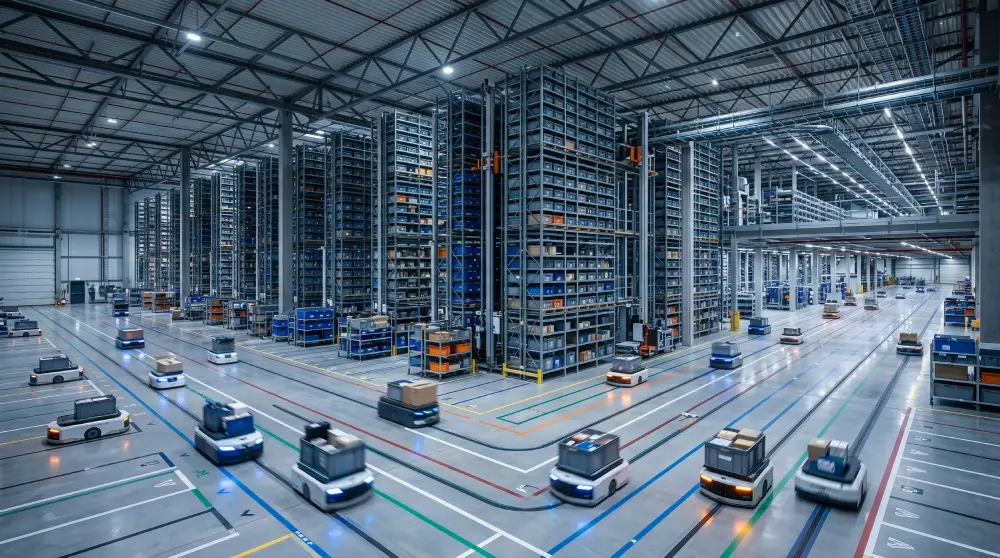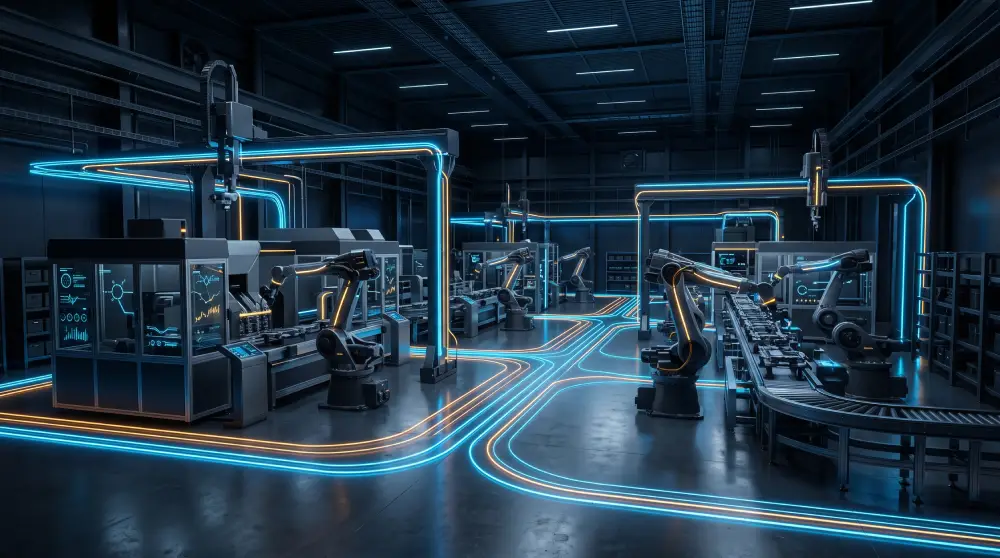

The way the world manufactures goods is undergoing one of the most significant transformations in industrial history. At the center of this revolution is smart factory technology, a powerful convergence of digital innovation, automation, and data intelligence that is reshaping how products are designed, produced, and delivered. From automotive plants in Germany to electronics facilities in South Korea, smart factories are setting a new standard for what modern manufacturing can achieve.
What Is a Smart Factory?
A smart factory is a highly digitized and connected production facility that relies on a continuous flow of data from connected operations and production systems to learn and adapt to new demands. Unlike traditional factories that depend on manual oversight and siloed operations, a smart factory integrates machines, people, and systems through a unified digital infrastructure.
Smart manufacturing is a broad category of manufacturing that employs computer integrated manufacturing, high levels of adaptability, and rapid design changes, along with digital information technology and more flexible technical workforce training. The concept builds on decades of industrial automation but takes it several steps further by embedding intelligence directly into the production process.
The Core Technologies Driving Smart Factories
Smart factory technology is not a single tool or software platform. It is an ecosystem of interconnected technologies that work together to create a self optimizing production environment. The most foundational of these technologies include the following.
The Industrial Internet of Things (IIoT) sits at the heart of every smart factory. Sensors embedded in machines, tools, and components collect real time data on temperature, pressure, vibration, output speed, and hundreds of other variables. This data flows continuously into centralized systems where it can be analyzed, visualized, and acted upon. The IIoT enables factory managers to monitor every corner of their operation from a single dashboard, identifying inefficiencies or failures before they become costly problems.
Artificial intelligence and machine learning take the raw data collected by IIoT devices and turn it into actionable intelligence. AI algorithms can predict when a machine is likely to fail, recommend optimal production schedules, detect quality defects at speeds no human inspector could match, and even suggest adjustments to reduce energy consumption. Machine learning models improve over time, meaning the factory becomes smarter the longer it operates.
Digital twin technology is another transformative pillar of the smart factory. A digital twin is a virtual replica of a physical asset, process, or entire production line. Engineers and operators use digital twins to simulate changes, test new configurations, and troubleshoot issues in a risk free virtual environment before applying them to the physical factory floor. Researchers at MIT’s Digital Engineering Laboratory have explored how digital twins reduce both development time and operational costs significantly.
Robotics and collaborative robots, commonly known as cobots, bring physical automation to smart factories. Unlike traditional industrial robots that operate in caged environments away from humans, cobots are designed to work alongside human workers safely. They handle repetitive, physically demanding, or precision tasks, freeing human employees to focus on higher value decision making and creative problem solving.
Cloud computing and edge computing work together to manage the enormous volume of data generated in a smart factory. Cloud platforms store and process large data sets and make them accessible across global operations. Edge computing, on the other hand, processes data locally on devices near the source, enabling real time responses where milliseconds matter, such as in quality inspection or safety shutdowns.
Key Benefits of Smart Factory Technology
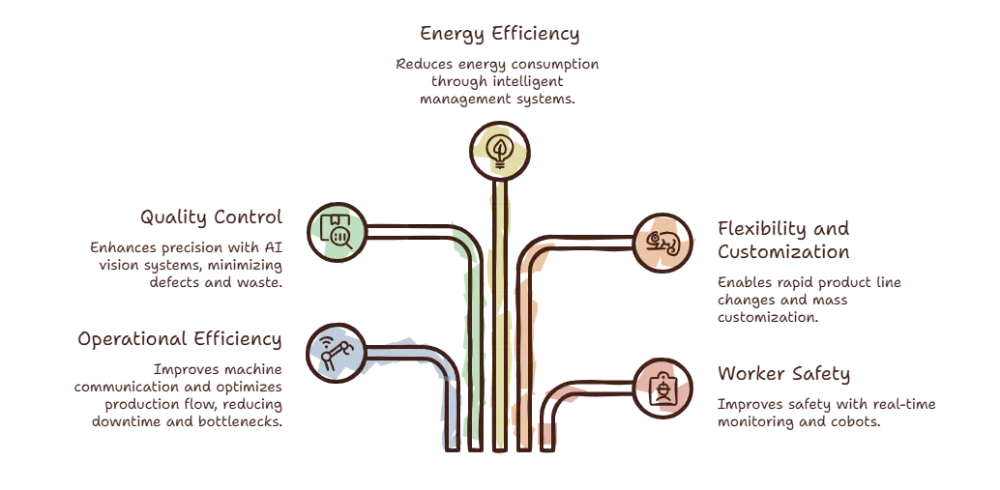
The advantages of adopting smart factory technology extend across virtually every dimension of manufacturing performance.
Operational efficiency improves dramatically when machines communicate with each other and with central management systems. Bottlenecks are identified automatically, downtime is minimized through predictive maintenance, and production flows are continuously optimized based on real time demand signals.
Quality control reaches new levels of precision. Vision systems powered by AI can inspect thousands of units per hour, identifying microscopic defects that human inspectors would miss. This leads to fewer recalls, less waste, and stronger brand reputation.
Energy efficiency is a growing priority for manufacturers worldwide, and smart factories deliver meaningful gains. Intelligent energy management systems monitor consumption across every machine and building system, automatically powering down idle equipment and balancing loads to reduce waste.
Flexibility and customization become viable at scale. Traditional mass production required long setup times whenever a product line changed. Smart factories, with their software defined processes and reconfigurable robotic systems, can switch between product variants rapidly, making mass customization economically practical.
Worker safety also improves significantly. Smart sensors monitor environmental conditions and worker locations in real time, alerting supervisors to hazardous situations before accidents occur. Cobots take over tasks that carry ergonomic risk, reducing injury rates across the workforce.
Smart Factory Technology and Industry 4.0
Smart factory technology is the operational backbone of what industry leaders and academics call Industry 4.0, the fourth industrial revolution. This term describes the current era of manufacturing transformation driven by cyber physical systems, the Internet of Things, and cloud computing.
Researchers at Purdue University’s College of Engineering have documented how Industry 4.0 frameworks guide manufacturers in implementing smart technologies in a structured and scalable way. The Purdue Model, originally developed as a reference architecture for industrial control systems, has been widely adapted as a foundation for understanding how data flows between operational technology and information technology layers in smart factories.
The shift toward Industry 4.0 is not exclusive to large corporations. Small and medium sized manufacturers are increasingly adopting modular smart factory solutions that allow them to begin digitizing specific processes and expand their capabilities over time, lowering the barrier to entry considerably.
Challenges in Implementing Smart Factory Technology
Despite its enormous promise, the journey toward a fully realized smart factory comes with real challenges that manufacturers must navigate thoughtfully.
Cybersecurity is one of the most pressing concerns. As more devices connect to networks and more data flows between systems, the attack surface for malicious actors expands. A cyberattack on a connected factory can halt production, compromise intellectual property, or even cause physical damage to equipment. Robust cybersecurity frameworks must be integrated from the earliest stages of smart factory design.
Data integration presents another hurdle. Many manufacturers operate legacy equipment that was never designed to communicate digitally. Bridging the gap between older machines and modern IIoT platforms requires specialized middleware and careful system architecture.
Workforce transformation is equally important. Smart factories do not eliminate the need for human workers, but they do change the nature of the skills required. Workers need training in data analysis, system monitoring, programming, and digital troubleshooting. Manufacturers that invest in upskilling their workforce gain a significant competitive advantage.
The Road Ahead for Smart Manufacturing
The trajectory of smart factory technology points toward even greater levels of autonomy, intelligence, and connectivity. Advances in 5G connectivity will enable faster, more reliable communication between devices on the factory floor, unlocking new possibilities for real time control and remote operation. Augmented reality tools will guide technicians through complex maintenance procedures using digital overlays projected onto their field of view.
As sustainability becomes a central business imperative, smart factories will increasingly use their data capabilities to minimize carbon footprints, optimize resource use, and support circular economy goals by reducing waste and enabling more precise material planning.
The integration of generative AI into manufacturing workflows is also beginning to accelerate, with early adopters using large language models to assist in process documentation, root cause analysis, and supply chain decision support.
Conclusion
Smart factory technology represents more than an upgrade to manufacturing operations. It is a fundamental reimagining of how goods are produced in the modern world. weaving together the IIoT, artificial intelligence, robotics, digital twins, and cloud computing, smart factories achieve levels of efficiency, quality, and adaptability that were simply not possible a generation ago. Organizations that embrace this transformation thoughtfully, investing in the right technologies, securing their systems, and developing their people, will be best positioned to lead in an increasingly competitive global marketplace. The smart factory is not a distant vision. It is being built today, one connected machine at a time.
FAQs
What is smart factory technology in simple terms?
Smart factory technology refers to a modern manufacturing environment where machines, systems, and people are connected through digital networks and powered by data. It uses tools like artificial intelligence, IoT sensors, robotics, and cloud computing to automate processes, monitor operations in real time, and make smarter decisions without constant human intervention. Think of it as a traditional factory that has been given a digital brain.
What is the difference between a traditional factory and a smart factory?
A traditional factory relies heavily on manual labor, fixed production lines, and reactive maintenance, meaning problems are addressed after they occur. A smart factory, by contrast, uses connected devices and AI to predict issues before they happen, adapt production in real time, and continuously optimize performance. Data flows freely between machines and management systems, enabling a level of speed, precision, and flexibility that traditional factories simply cannot match.
How does smart factory technology improve product quality?
Smart factories use AI powered vision systems and sensor networks to inspect products at every stage of production with far greater accuracy and speed than human inspectors. Defects are detected and flagged instantly, reducing waste and preventing faulty products from reaching customers. Consistent machine performance, guided by real time data, also means fewer variations in the production process, which directly translates to higher and more uniform product quality.
Is smart factory technology only suitable for large manufacturers?
Not at all. While large enterprises were early adopters, smart factory solutions today are increasingly modular and scalable, making them accessible to small and medium sized manufacturers as well. Many technology providers offer entry level IIoT platforms and cloud based tools that allow smaller operations to begin their digital transformation with a specific process or production line and expand gradually as they see returns on their investment.
What skills do workers need in a smart factory environment?
Workers in smart factories need a blend of technical and analytical skills that go beyond traditional machine operation. Key competencies include the ability to interpret data dashboards and reports, basic understanding of programming and automation systems, familiarity with robotics and collaborative robot operation, and digital troubleshooting skills. Soft skills like problem solving and adaptability are equally valuable, as smart factory environments evolve rapidly and require workers to continuously learn and adjust to new tools and processes.